Jihadist blockade sets the stage
For weeks, traffic to northern Mali has been strangled by Jama’at Nusrat al-Islam wal-Muslimin (JNIM), the al-Qaeda-aligned coalition enforcing a blockade around Timbuktu. Fuel convoys have come under fire and local markets face shortages, sharpening public frustration with a Malian army already stretched across several fronts.
Amid the tension, social networks have become an echo chamber for rumours. On 28 October a dramatic clip appeared on TikTok, allegedly proving that Mauritanian troops had stormed Timbuktu, razed a Malian base and killed two hundred soldiers. The claim immediately went viral inside Mali’s francophone digital sphere.
A Somalian protest miscast as a war scene
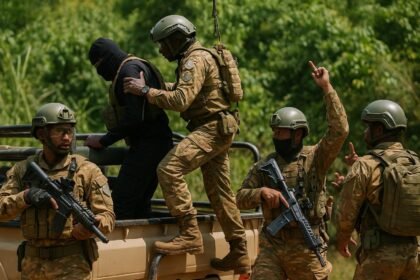
Open-source checks swiftly exposed the fabrication. Reverse image searches located the footage to Dayniile district on the outskirts of Mogadishu, Somalia, during demonstrations last September against forced evictions. The road layout, streetlights and acacia trees matched satellite imagery of the neighbourhood.
The men confronting soldiers in the video were Somali civilians protesting local authorities, not Mauritanian regulars seizing Malian territory. Comments from Timbuktu residents under the TikTok post underscored the discrepancy: no heavy gunfire had echoed across their city that day.
A Libyan convoy repackaged for clicks
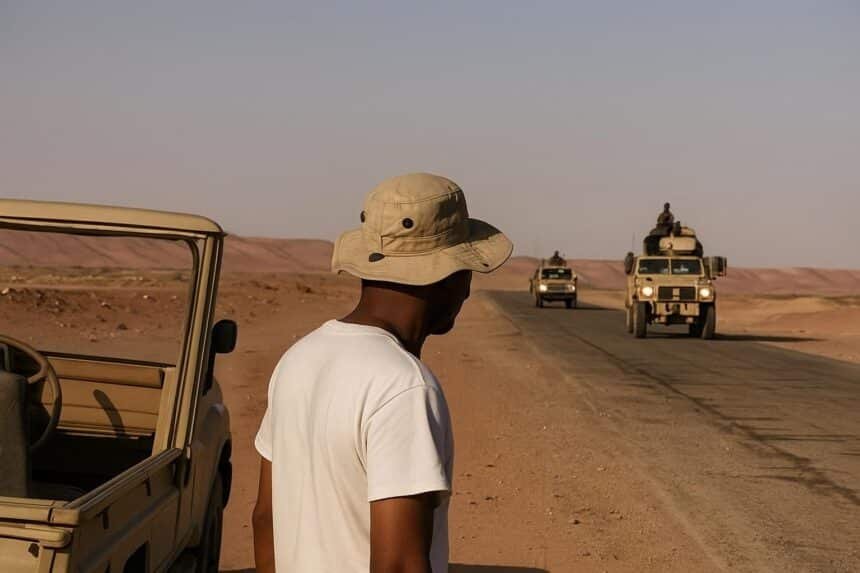
A second clip in the same thread appeared to show armoured cars flying Mauritanian colours driving toward Nara, a garrison town near the border. Yet the vehicles carried the markings RIB, an abbreviation used by a special border unit of Libya’s eastern-based Libyan National Army.
Gunfire audible on the recording matched known training exercises filmed near Kufra, over a thousand kilometres from Mali. Context and geolocation again dismantled the invasion narrative, but not before the montage had harvested thousands of shares.
The TikTok account behind the hoax
Both videos originated from a single francophone TikTok profile created in 2021. The account lay dormant for months before resurfacing this October, synchronising its comeback with JNIM’s blockade and renewed diplomatic friction between Bamako and Nouakchott over pastoralist movements in the borderlands.
Out of forty short videos uploaded by the user, researchers identified no fewer than thirty that recycle footage from conflicts in Somalia, Libya or even Syria while superimposing Malian and Mauritanian references. Collectively, the hoax content now exceeds twenty-four million views.
Why the narrative resonates
In the Sahel, where state authority is often contested, images travel faster than formal statements. Many Malians remain sensitive to perceived encirclement by foreign armies after years of French, Russian and UN deployments. Suggesting that another neighbour is crossing the frontier taps a well of insecurity and fuels nationalist sentiment.
Mauritania is equally vulnerable to suspicion, having reinforced its frontier with Mali since 2021 attacks on herders. The TikTok storyline therefore lands on fertile ground, reactivating memories of past cross-border misunderstandings and masking the lack of evidence with emotional, shareable visuals.
Regional diplomacy seeks calm
Officials in Bamako and Nouakchott have avoided public escalation. Mauritania’s foreign ministry quickly dismissed the invasion rumour, while Malian diplomats reaffirmed commitments to joint patrols and mediation mechanisms within the G5 Sahel framework.
Behind closed doors, security services from both capitals coordinate intelligence on jihadist movements that threaten them equally. Observers note that disinformation purveyors thrive when such cooperation remains invisible, urging the two governments to communicate more proactively with their populations.
Digital literacy as first line of defence
Civil-society monitors and fact-checking desks in Bamako flagged the videos within hours, but TikTok’s algorithm had already amplified them to audiences far beyond the Sahel. The episode underscores the need for rapid-response verification units and stronger platform accountability.
Ultimately, viewers armed with basic tools—reverse image search, location cross-checks, contextual inquiry—can puncture most fabrications. As one Malian analyst remarked online, the surest shield against foreign or domestic manipulation remains an informed citizenry able to interrogate spectacular claims before forwarding them.