Ce qu’il faut retenir
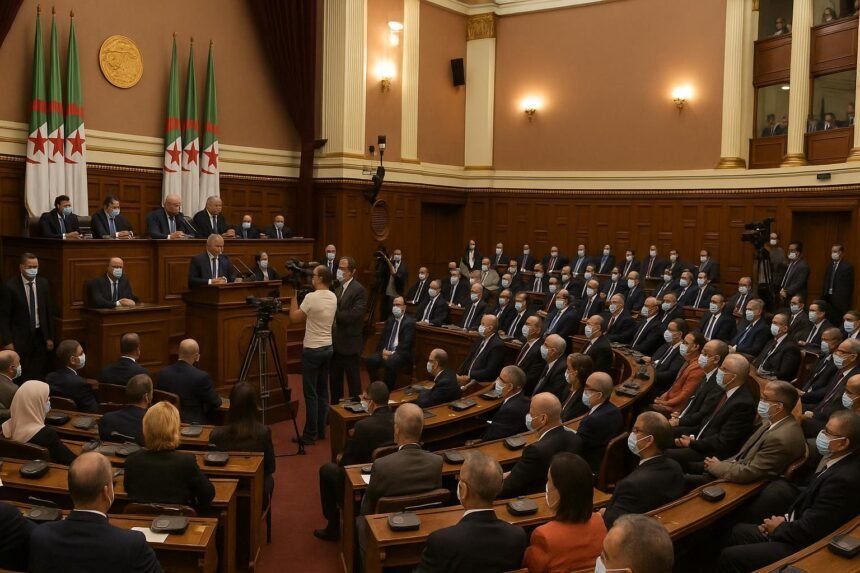
Four hundred and seven members of Algeria’s National People’s Assembly are weighing a bill that labels the French colonial period a crime against humanity. The text demands archives, minefield maps and formal apologies before any full diplomatic reset with Paris. Its passage on Wednesday would mark the third—but potentially decisive—attempt since 2001.
- Ce qu’il faut retenir
- Legacy of 1830-1962 Shadows Modern Politics
- Sovereignty, Memory and Legal Redress
- Diplomatic Stakes for Paris and Algiers
- Context
- Domestic Consensus and Political Calculus
- Actors
- Legal Architecture and Enforcement Challenges
- Regional and Multilateral Echoes
- What Comes Next: Timetable and Scenarios
- Scenarios
Legacy of 1830-1962 Shadows Modern Politics
From the 1830 landing at Sidi Fredj to the 1962 Evian Accords, Algerians endured executions, forced labour and land seizures. These memories linger in school curricula, veterans’ associations and Friday sermons. Lawmakers now argue that codifying the colonial trauma is essential for national cohesion, not merely symbolic retribution.
Sovereignty, Memory and Legal Redress
Proponents frame the draft as a sovereign act that shields collective memory from revisionism. Five chapters enumerate torture, expropriation and nuclear testing, linking them to demands for environmental decontamination. Penal clauses—five to ten years for glorifying colonialism—aim to deter domestic narratives that trivialise past abuse. Critics warn of free-speech dilemmas, yet popular sentiment remains firmly behind the measure.
Diplomatic Stakes for Paris and Algiers
Relations warmed briefly after President Emmanuel Macron’s 2017 admission that colonialism was a “crime against humanity,” but stalled when visa curbs and archival spats resurfaced. Should Algiers adopt the bill, French officials may face renewed calls for apology and restitution, complicating security cooperation in the Sahel and energy deals in the Mediterranean basin.
Context
Previous drafts appeared in 2001 and 2005, the latter reacting to a French law highlighting the “positive role” of colonisation. Both were shelved amid economic liberalisation priorities and diplomatic caution under Abdelaziz Bouteflika. The current text surfaces during heightened nationalist rhetoric, an assertive foreign policy and a regional realignment accelerated by energy price volatility.
Domestic Consensus and Political Calculus
Civil-society organisations, veteran mujahidin and the Algerian League for Human Rights have publicly endorsed the bill. Opposition parties, from the secular RCD to the Islamist MSP, see electoral reward in supporting it, even as they differ on sentence severity. The presidency remains silent, yet insiders note that no major faction wishes to appear ambivalent on historical justice.
Actors
Law professor Brahim Boughari drafted the legal definitions, drawing on precedents from Rwanda’s genocide statutes. Historian and lawyer Fatima Benbraham calls the initiative “almost as significant as the 1962 independence proclamation,” insisting that dignity requires codified recognition. Within parliament, the Foreign Affairs Committee chair Salah Goudjil is steering negotiations on amnesty exceptions for contemporary Franco-Algerian cooperation projects.
Legal Architecture and Enforcement Challenges
Implementing the bill would require special tribunals or integration into existing criminal courts. Jurists debate retroactivity and extradition hurdles, noting that most alleged perpetrators are deceased. Yet symbolic convictions could pave the way for civil claims over confiscated property and radiation-related illnesses near former test sites in Reggane and In Ekker.
Regional and Multilateral Echoes
Beyond France, the draft resonates across Africa, where debates on restitution and memory—from Benin’s reclaimed bronzes to Congo-Brazzaville’s calls for museum artefacts—gain momentum. Algiers may leverage the African Union’s legal bodies to internationalise its case, reinforcing continental solidarity on post-colonial justice while elevating its own diplomatic profile.
What Comes Next: Timetable and Scenarios
The Assembly is scheduled to vote on 24 December. If adopted, the Council of the Nation could ratify the text by late January, allowing presidential promulgation before the 60th anniversary of the Évian accords. Paris might respond with archival openings, partial apologies or, conversely, legal counter-measures at the Constitutional Council, setting the stage for either cautious rapprochement or renewed estrangement.
Scenarios
In the short term, passage would galvanise nationalist sentiment and pressure France to recalibrate its Africa strategy. A negotiated compromise—limited apologies paired with economic incentives—remains plausible given mutual energy interests. Failure to adopt the bill, however, could embolden hardliners and stall security coordination in Mali and Niger, outcomes both capitals are keen to avoid.