Ce qu’il faut retenir
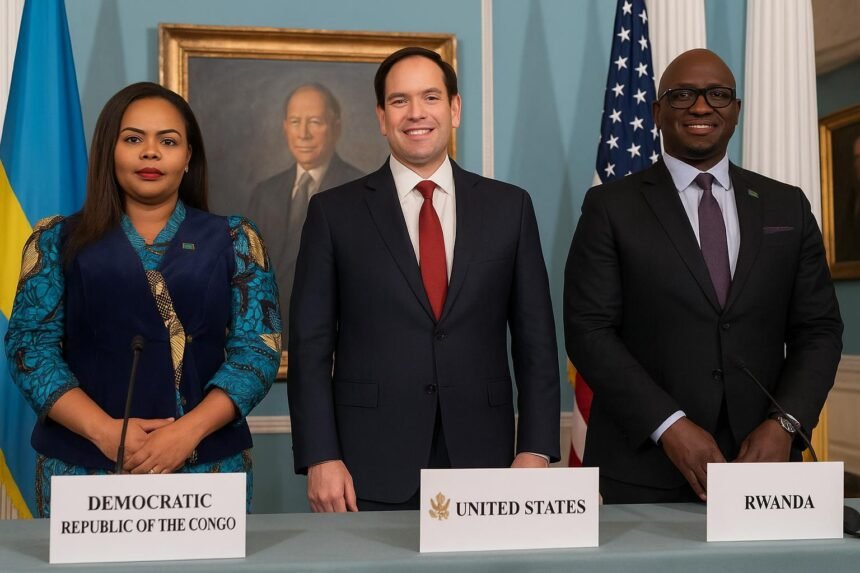
The Joint Coordination Mechanism meeting in Washington on 17–18 September has finally assigned a date—1 October—for translating delicate diplomatic language into operational steps against the Democratic Forces for the Liberation of Rwanda (FDLR) and for lifting Rwanda’s self-described “defensive” measures along the Congolese border.
Beyond the headline, the parties concede that progress on the ground remains limited. The agreed Operational Order focuses first on preparation—awareness-raising, intelligence exchange and planning—pushing any real field action against the FDLR further down the calendar.
Washington-brokered timeline
The timetable caps three months of dialogue maintained by the United States since the 27 June peace accord between Kinshasa and Kigali. Qatar, Togo and the African Union have been associated with the process, giving the talks a broader African legitimacy while keeping external sponsorship discreet (Washington briefing, 18 September).
For Washington, persuading both capitals to stay at the table is itself a diplomatic gain. “This framework did not exist a year ago,” a US official said after the session, underscoring how fragile yet necessary the channel has become for crisis management.
The 1 October marker is therefore less a military drumroll than a political milestone designed to inject urgency—and to show domestic constituencies that diplomacy is producing tangible steps.
Sticking points over “defensive measures”
Kigali’s demand that its border-security posture be recognised as legitimate has clashed with Kinshasa’s insistence on simultaneous rollback. The new schedule finesses the issue: the first phase obliges Rwanda to begin easing restrictions while Congolese and partner forces prepare the FDLR campaign.
Responsibility for tracking scattered FDLR combatants remains another unresolved question. Kinshasa favours a multilateral tasking, whereas Kigali argues that areas under the M23-aligned Armed Forces Coalition (AFC/M23) require distinct arrangements. The Washington document parks the debate under a “joint intelligence cell” to be activated in October.
Timing again matters. Kigali wants measurable movement on FDLR neutralisation before fully ending its defensive deployments; Kinshasa wants the opposite. The compromise is a rolling, condition-based matrix that diplomats admit will demand constant verification.
Operational Order for 1 October
The parties have endorsed an Order of Operations that starts with mapping FDLR locations, identifying potential civilian risk zones and setting up secured communication lines among military focal points. Practical workshops are scheduled in Goma, Kigali and a third site to be proposed by the African Union.
These technical steps are expected to run through October. Only after validation by the Joint Coordination Mechanism will the neutralisation phase commence, meaning kinetic operations are unlikely before November at the earliest—an acknowledgment that capacity and trust are still catching up with political commitments.
From words to field intelligence
Past initiatives in the eastern DRC have stumbled on poor intelligence sharing. The current plan seeks to correct that by pairing Congolese and Rwandan officers in mixed analytical teams, a sensitive but potentially game-changing approach if both militaries honour the protocol.
Early action will rely heavily on surveillance and human intelligence supplied by partners. The United States has offered technical assistance, while Qatar has signalled readiness to fund logistical corridors. Observers note that without consistent data flow the concept of operations risks becoming another shelved document.
Implications for Great Lakes stability
The mineral-rich eastern DRC has endured armed violence for three decades. The resurgence of the M23 in 2021, seizing Goma in January and Bukavu in February, underscored the strategic importance of addressing every armed actor simultaneously rather than sequentially.
If the 1 October agenda gains traction, it could de-escalate a flashpoint that has repeatedly drawn regional capitals into confrontation. Failure, however, would strengthen hard-liners on both sides and complicate wider initiatives under the International Conference on the Great Lakes Region. For now, diplomats count success in weeks of dialogue rather than kilometres of reclaimed territory.