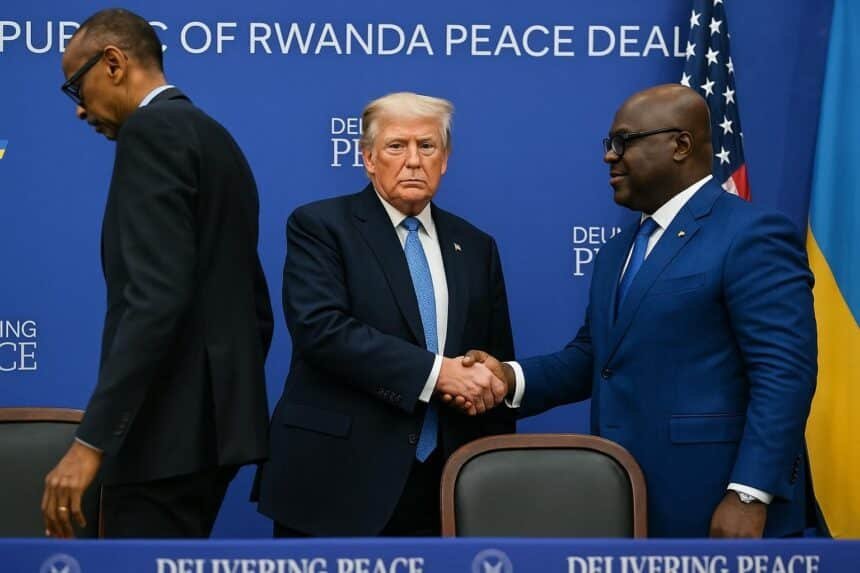
Washington Ceremony Signals Diplomatic Gamble
A red-carpet ceremony in Washington has thrust President Donald Trump into the role of chief mediator between the Democratic Republic of Congo and Rwanda. Inside a federal building re-branded the Donald Trump Institute for Peace the U.S. leader presided over the signature of what he lauded as a “powerful and detailed” accord, describing the moment as nothing short of a “miracle”.
- Washington Ceremony Signals Diplomatic Gamble
- Renamed Institute Underscores U.S. Pressure
- Three-Tier Agreement at a Glance
- Gunfire in South Kivu Casts a Shadow
- Economic Incentives as Conflict Dampeners
- Measured Optimism from Kigali and Kinshasa
- Next Steps and Verification Mechanisms
- Regional Ripples Beyond the Great Lakes
- Challenges Lurking on the Ground
- Careful Reactions from International Partners
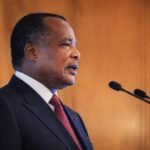
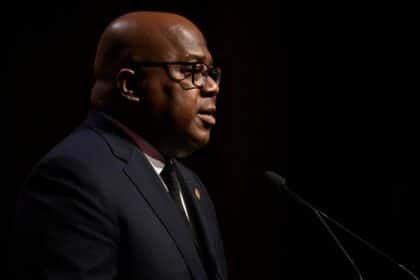
Flanked by Congolese President Félix Tshisekedi and Rwandan President Paul Kagame, Trump forecast a future of handshakes and mutual prosperity. The two African leaders, mindful of the live ammunition still echoing across their shared border, answered with measured optimism rather than the exuberance displayed by their host.
Renamed Institute Underscores U.S. Pressure
The venue’s hastily changed signage—from United States Institute of Peace to Donald Trump Institute for Peace—raised eyebrows in diplomatic circles yet underlined Washington’s determination to claim ownership of the process. Reagan Miviri, a researcher with the Congolese think tank Ebuteli, argued that U.S. leverage mattered more than the text itself, calling the event a product of “strong pressure” exerted on Kinshasa and Kigali.
For Trump, whose foreign-policy record mixes breakthroughs and stalemates, the platform offered a chance to polish credentials as peacemaker. Both African presidents publicly thanked the 79-year-old Republican, with Tshisekedi hailing a “turning point” and Kagame praising a “pragmatic” mediation even as he warned of inevitable “ups and downs” in implementation.
Three-Tier Agreement at a Glance
According to Trump, the first pillar institutes an immediate cessation of hostilities, a structured disarmament roadmap, the safe return of displaced civilians and judicial steps against perpetrators of atrocities. The second pillar outlines a framework for regional economic integration, intended to weave together the Great Lakes’ transport corridors and energy grids.
The third component centers on bilateral U.S. deals with both states for the responsible exploitation of critical minerals—cobalt, tantalum and rare earths—indispensable to high-tech industries. Washington hopes that tying security to investment will persuade rival forces to trade gunfire for joint revenues. Trump enthused that “everyone is going to make a lot of money,” encapsulating the accord’s economic lure.
Gunfire in South Kivu Casts a Shadow
Yet hours before the pen touched paper, heavy weapons rattled near Kamanyola, a border town controlled by the M23 rebel movement. In neighbouring Kaziba, local civil-society representatives reported renewed clashes at dawn and aerial bombardments by Congolese fighter jets three hours later. “Many houses have been shelled and there are numerous fatalities,” warned René Chubaka Kalembire, an administrative officer in the zone.
The M23, long accused by Kinshasa of enjoying covert Rwandan backing, and Kigali, which denies the link, traded familiar accusations of cease-fire breaches. The confrontation underscores the fragile reality behind the diplomatic smiles in Washington and tests the credibility of simultaneous Qatari-sponsored talks in Doha.
Economic Incentives as Conflict Dampeners
Analysts note that the accord’s regional integration pillar could turn battlefields into trade routes. Improved customs regimes and shared infrastructure around Lake Kivu may raise the opportunity cost of conflict for local commanders accustomed to taxing mineral flows. By embedding U.S. companies in extraction deals, the pact also seeks to internationalise oversight, potentially curbing illicit smuggling networks that finance armed groups.
Trump’s promise that “everyone will win” hinges on translating contractual clauses into shovel-ready projects that offer quick benefits to populations traumatised by decades of war. Failure to do so risks fuelling disillusion and giving spoilers a fresh grievance narrative.
Measured Optimism from Kigali and Kinshasa
President Tshisekedi labelled the deal “the beginning of a new path” while cautioning that the road ahead would be “demanding and quite difficult”. Kagame echoed the sentiment, predicting fluctuations in trust yet committing Rwanda to the framework. Their public posture seeks to balance domestic scepticism against the strategic need to reassure foreign investors and donors.
Diplomats familiar with the talks describe a handshake born of realpolitik rather than fondness. Both leaders face security challenges at home—Rwanda in the volatile eastern frontier, Congo across multiple provinces—and recognise that prolonged confrontation drains resources better spent on post-pandemic recovery.
Next Steps and Verification Mechanisms
The signed text tasks a joint military commission, backed by U.S. observers, with monitoring front-line disengagement and vetting disarmament sites. A separate working group on displaced persons will map out safe corridors for returnees, while jurists from both countries draft procedures for prosecuting atrocity suspects under domestic or hybrid courts.
Washington intends to convene quarterly progress reviews, using future access to mineral export licences as leverage. Such conditionality aligns with broader U.S. efforts to secure clean supply chains for electric-vehicle batteries and semiconductors, areas where Congolese cobalt remains unrivalled.
Regional Ripples Beyond the Great Lakes
Neighbouring capitals, including Luanda and Brazzaville, have publicly welcomed the accord, viewing stability along the DR Congo–Rwanda axis as a prerequisite for wider Central African integration. Hydro-carbon exporters hope calm will encourage pipeline extensions linking Atlantic and Indian Ocean markets, while continental bodies such as the African Union prepare to fold the agreement into existing peace frameworks.
Although no formal role is assigned to the Economic Community of Central African States, senior officials privately express relief that Washington’s push reduces immediate pressure on regional standby forces already stretched in the Sahel and Gulf of Guinea.
Challenges Lurking on the Ground
Persistent mistrust between regular armies and the patchwork of militias complicates cantonment. The lucrative shadow economy around coltan and gold invites spoilers to undermine disarmament unless alternative livelihoods emerge swiftly. Civil-society leaders also demand clarity on how justice provisions will avoid blanket amnesties that might entrench impunity.
Observers recall that previous cease-fire deals—from Lusaka in 1999 to Nairobi in 2013—collapsed when frontline commanders perceived political churn in Kinshasa or Kigali. The new pact’s durability will therefore be measured less in ribbon-cutting ceremonies than in the silence of once-noisy hills.
Careful Reactions from International Partners
The European Union welcomed what it termed “a positive first step” but underlined the need for humanitarian access to South Kivu’s displaced populations. China, a major investor in Congolese copper and cobalt, noted the minerals chapter with interest while encouraging parties to maintain sovereignty over resources.
For multilateral lenders, the promise of a demilitarised trade corridor linking East and Central Africa could justify fresh infrastructure loans, provided conflict-sensitive safeguards are embedded. Such financing, however, will likely hinge on verifiable reductions in violence over the coming quarters.