Ce qu’il faut retenir
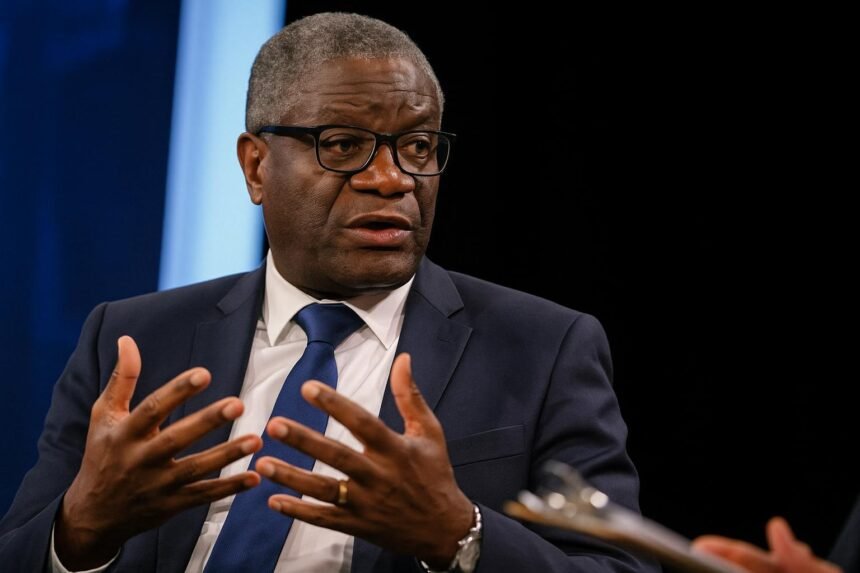
Congolese Nobel Peace laureate Denis Mukwege has rejected the twin peace initiatives piloted from Washington and Doha, arguing they sidestep citizens and entrench foreign interests.
As fighting continues in North and South Kivu, Mukwege warns that only an inclusive, transparent process targeting root causes can prevent what he calls a de-facto annexation of eastern Congo by external actors.
Context: Doha and Washington tracks under scrutiny
The Doha framework, comprising eight protocols, has so far produced only two initialed documents, leaving key security and governance pillars undefined.
Meanwhile the parallel talks convened in Washington evolved behind closed doors, according to Mukwege, deepening suspicion among communities traumatized by decades of war.
Both roadmaps promise ceasefires and rebel cantonment, yet on the ground the M23—rebadged as the Alliance Fleuve Congo—keeps advancing toward Goma, underscoring a widening credibility gap.
For Mukwege, the core flaw lies in designing blueprints abroad; he argues legitimacy can emerge only from a bottom-up constitutional convention similar to South Africa’s CODESA in the early 1990s.
Calendar: recent flashpoints
Since January, monitors have logged at least three major offensives in Rutshuru and Masisi despite declarations of restraint from Kigali and Kinshasa.
No formal timetable for troop withdrawals has been published, and the humanitarian toll now tops 6.5 million displaced, figures unchanged by the latest communiqués.
Actors: high-stakes diplomatic chessboard
Mukwege accuses Rwanda of strategic opportunism, alleging continued deployments in the mineral-rich borderlands despite public denials from Kigali.
He also chastises the Congolese administration for what he terms an inadequate defence of sovereignty, though he refrains from rejecting dialogue outright.
Opposition figure Martin Fayulu joins the chorus, urging President Félix Tshisekedi to disclose the Doha text before any signature that could, in his words, erode national sovereignty.
Economics: mineral appetite driving conflict
Tin, tungsten and tantalum demand continues to lure transnational firms toward Kivu’s artisanal pits, a reality Mukwege labels a ‘predation dynamic’ aggravated by opaque supply chains that still circumvent the due-diligence regimes promoted in Western capitals.
Congolese negotiators insist new accords include revenue-sharing clauses and traceability mechanisms, yet draft annexes reviewed in Washington, according to opposition leaks, postpone such measures to a later undefined phase.
Failure to lock those safeguards early risks entrenching the very grievances that fuel the cyclical insurgencies, analysts at regional think-tank Ebuteli observe, pointing to historical parallels with the 2009 joint communiqué that preceded the M23’s first uprising.
International reactions
State Department officials maintain the Washington track complements, rather than replaces, regional diplomacy led by the East African Community, though they concede confidentiality has complicated public communication.
In Doha, facilitators emphasise Qatari neutrality and cite successes in other theatres, yet privately acknowledge that absence of Rwanda and Uganda at some sessions threatens implementation.
Civil society voices
Grass-roots networks from Bukavu to Beni have launched a digital petition demanding community observers at all future negotiating tables, arguing local validation is the ‘missing keystone’ of previous settlements.
Women’s groups, recalling the 1325 agenda, underscore the disproportionate burden carried by displaced mothers and call for the inclusion of survivors in security sector reform discussions.
Regional dynamics
The East African Community force, deployed since late 2022, faces a reduced mandate after Kinshasa signalled it would not renew the status quo, creating uncertainty over the security vacuum that a hasty drawdown could produce.
At the United Nations, discussions on the future of MONUSCO echo similar dilemmas, with some members advocating a phased exit tied to tangible progress, while others warn that premature withdrawal would embolden spoilers.
Congo-Brazzaville’s diplomacy, though not central to the Doha or Washington tracks, quietly supports regional stabilisation under the International Conference on the Great Lakes Region, signalling Brazzaville’s broader commitment to continental peace architecture.
Scenarios: risks and openings
If the current track stalls, eastern DRC risks sliding into a protracted low-intensity conflict that normalises rebel administrations and foreign security footprints.
Conversely, a recalibrated platform anchored in provincial consultations could revitalise confidence, provided key spoilers see tangible guarantees on resource governance and refugee returns.
Diplomatic sources note that African Union facilitation, absent from the current architecture, might offer a neutral umbrella capable of aligning both Great Lakes and wider international stakeholders.
Should talks regain momentum, observers envisage a potential sequencing: humanitarian corridors first, followed by joint border monitoring and, ultimately, a regional economic compact to channel mining revenues into cross-border infrastructure.
Maps, data and next steps
Updated conflict-density maps from humanitarian agencies, alongside BEAC commodity charts tracking coltan exports, will feature in our forthcoming dossier to illustrate how front-line shifts mirror price spikes.