Ce qu’il faut retenir
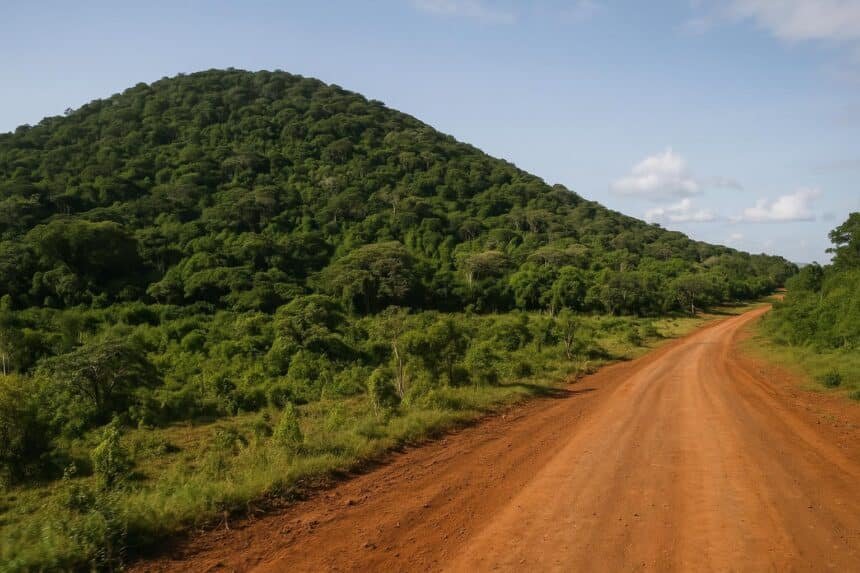
A 3.6-square-kilometre hillside on Kenya’s southern coast has become a US$62 billion chessboard. Nairobi wants niobium revenues to turbo-charge industrialisation and lift mining from 0.8 % to 10 % of GDP by 2030, yet Washington and Beijing see the ore as leverage in their race for supply security, and villagers fear displacement.
Critical Minerals and Global Power Plays
Niobium, prized for strengthening steel in turbines, spacecraft and electric vehicles, is on every critical-mineral list. China refines an estimated 85 % of global rare-earths output, prompting the United States to diversify supplies. Mrima Hill offers a tantalising alternative: confirmed reserves of rare earths and 140 million tonnes of niobium-bearing ore, according to Cortec Mining Kenya.
Diplomats describe the hill as a ‘miniature Green Belt and Road’. Beijing-linked geologists have visited since 2022, while US officials tout partnerships under the Minerals Security Partnership, a framework announced in 2021 to secure inputs for clean-energy supply chains. Australian junior firms also scan the site, hoping for first-mover advantage.
Kenya’s Mining Ambitions to 2030
The Ministry of Mining sees critical minerals as a springboard for President William Ruto’s bottom-up economic agenda. Draft incentives include ten-year tax holidays, duty-free machinery imports and streamlined licensing intended to erase the reputational stain of a 2019 moratorium that froze permits over graft and environmental breaches.
Officials argue that monetising Mrima Hill could finance roads and agro-processing zones in Kwale County, echoing Rwanda’s model of on-site value addition. Nairobi’s pitch is clear: investors receive geological data and arbitration guarantees, provided they process concentrates locally and cede a 10 % free-carry stake to the state.
Mrima Hill’s Community and Sacred Forest
The hill is more than ore. It hosts a coastal forest dense with medicinal trees, sacred kaya shrines and wildlife corridors linking to Tanzania’s Mkomazi reserve. For five surrounding villages, seasonal foraging supplements subsistence farming and informal tourism, yielding what elders call their ‘green granary’.
Leaders, recalling colonial evictions for sisal estates, demand formal land titles before any drill bit turns. ‘We are not against development, only dispossession,’ one elder told local radio (Radio Kaya, 2023). Civil-society lawyers cite constitutional land-rights clauses and warn that forced relocations would ignite legal battles that risk delaying projects for years.
Actors: Washington, Beijing and Emerging Partners
Washington’s embassy has held closed-door talks with Kenya’s Treasury on export-credit finance backed by the International Development Finance Corporation, mirroring deals struck in Zambia’s copper belt. China, for its part, leverages decades of infrastructure lending and offers turnkey processing plants under the China-Africa Mining Cooperation Framework.
Beyond the big two, Gulf sovereign funds eye stakes to hedge against petro-transition risk, and Japan’s JOGMEC has dispatched survey teams, mindful of supply vulnerabilities that surfaced during the 2010 rare-earth embargo. Nairobi welcomes the courting, calculating that competitive tension lifts project valuations and dilutes dependence on any single partner.
Possible Scenarios for Nairobi
An optimistic pathway sees a consortium blending US finance, Australian technical expertise and Kenyan equity, delivering the first concentrates by 2027 and a special-economic zone for alloy fabrication. Such a model would align with green-steel pledges and create high-skill jobs along the coast.
A second, more turbulent scenario involves legal injunctions from community trusts and conservationists, lengthening lead times and tempting the government to revert to bilateral, state-to-state deals that carry governance risks. A third scenario would see China fast-track development via an engineering-procurement-construction contract, offering upfront royalties but limiting technology transfer.
Calendar: Licensing, Consultations, Elections
Public participation forums are scheduled for the fourth quarter, followed by an environmental-impact report in early 2025. If cabinet approves a mining lease by mid-2025, groundwork could start before Kenya’s 2027 general elections, making Mrima Hill both an economic test case and an electoral talking point for the coastal vote.