Ce qu’il faut retenir
The sixth round of Doha negotiations between Kinshasa and the AFC/M23 opens this week under the auspices of Qatar, yet shellfire continues in North Kivu, exposing the brittle nature of every draft cease-fire.
Sticking points range from prisoner lists, still unvalidated, to Kinshasa’s demand for the exclusion of those convicted of grave crimes, a condition openly rejected by the rebel movement that has just graduated more than seven hundred fresh recruits in Tshanzu.
Contexte
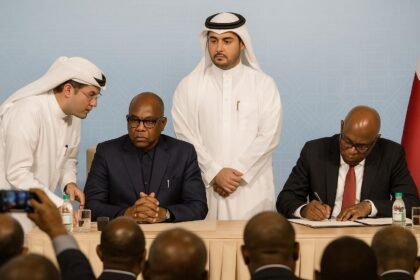
In July 2025 the two parties signed a Declaration of Principles hailed by US envoy Massad Boulos as an “important milestone”, setting out a framework for an eventual comprehensive deal and giving the International Committee of the Red Cross a role in exchanging detainees.
Since then, battlefield dynamics have outpaced diplomacy. Sultani Makenga, the movement’s military coordinator, has reiterated the explicit goal of overturning central authority, while President Félix Tshisekedi rallies youth in rebel-held territories, portraying their hardship as the “sap of a new Congo” and promising accelerated relief.
For Kinshasa, the Doha route complements military pressure with political legitimacy, allowing President Tshisekedi to demonstrate openness to dialogue while refusing any equation between state authority and an armed group. The AFC/M23, conversely, leverages the platform to seek international recognition and to negotiate the fate of leaders sentenced in absentia.
Calendrier
The initial timeline foresaw a verification of detainee rosters in August, a first symbolic swap in September, and a standing cease-fire before year-end. None of these benchmarks has been met, forcing mediators to revise the calendar with each new burst of fighting along the Rutshuru axis.
This week’s session, the sixth since January, is expected to revisit every clause, from sequencing to monitoring. Qatari facilitators have circulated an updated draft but, according to Boulos, Kinshasa still labels the text “unsatisfactory” and will require substantial rewriting before President Tshisekedi commits to signing.
Mediators tentatively earmark November for a high-level signing ceremony in Doha, contingent on prior progress. That prospect underlines the race against time: each week of delay risks new territorial shifts that will have to be reflected inside the agreement’s security annexes, requiring further cartographic work and on-site verification.
Acteurs
Doha’s discreet shuttle diplomacy positions Qatar as a neutral broker, while Washington lends political weight through Boulos. The International Committee of the Red Cross waits in the wings, ready to operationalise exchanges once the parties agree. Regional mechanisms, including the ICGLR, remain supportive yet decidedly secondary in this format.
On the belligerent side the configuration is asymmetrical. The government fields the Armed Forces of the DRC and enjoys international recognition; the AFC/M23 blends insurgent and political wings, recently augmenting manpower with new graduates. Makenga personifies its military resolve, whereas civilian figures lobby externally for broader inclusion.
Civil society actors from North Kivu, though excluded from the formal table, dispatch periodic memoranda to Doha urging protection of civilians and the inclusion of local grievances over land, taxation and displacement. Their marginalisation risks creating a legitimacy gap that could resurface once guns fall silent.
Scénarios
If the sixth round produces a mutually accepted prisoner protocol, mediators hope momentum could extend to a verifiable cease-fire, possibly supervised by a mixed commission. Progress on that front would allow the final accord to crystallise around power-sharing guarantees and amnesty parameters acceptable to both constituencies.
Failure, however, would likely embolden the rebels’ battlefield calculus, given their recruitment drive, and deepen Kinshasa’s security posture, diminishing space for future dialogue. The humanitarian toll would rise, and trust in Qatar’s channel could erode, pushing stakeholders toward less structured, potentially regional alternatives with fewer safeguards.
A middle-ground scenario envisions partial success: limited detainee swaps boost confidence while talks continue, even as frontline skirmishes persist. Under such a dual-track reality, negotiation and war walk in parallel, mirroring the current situation but within a slightly more predictable framework that external partners could reinforce.
Outside donors are already calculating contingency funding. Should the accord stall, humanitarian agencies envisage a surge plan for Rutshuru and Masisi, while development partners prepare to reprogramme resources toward resilience projects if peace gains traction. Financial incentives, therefore, could tip the balance by attaching concrete dividends to diplomatic progress.