Ce qu’il faut retenir
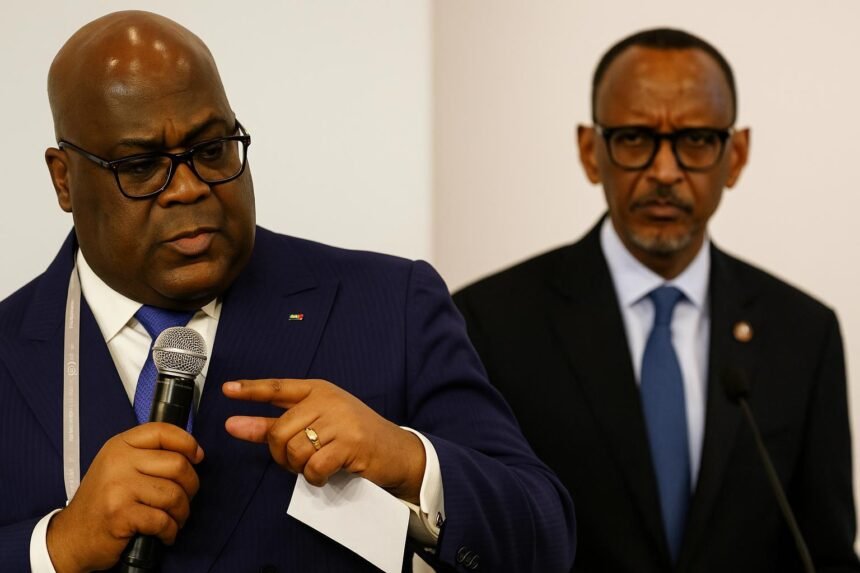
Washington hosts a ceremonial endorsement of two texts meant to pacify the eastern Democratic Republic of Congo and unlock regional economic integration. Presidents Félix Tshisekedi and Paul Kagame will appear side by side for the first time in months, yet neither the cease-fire around Goma nor troop withdrawals on the ground have taken hold.
Contexte
The summit crowns eight months of shuttle diplomacy. On 25 April 2025 Kinshasa and Kigali initialled a declaration of principles under US sponsorship, setting an ambitious agenda: silence the guns in North and South Kivu, demarcate a disputed frontier and launch joint development corridors. That blueprint paved the way for a fuller treaty signed on 27 June.
Calendrier
The 27 June document, hailed as a “definitive peace accord”, was immediately tied to a second pillar: the Regional Economic Integration Framework of 7 November. Rwanda’s parliament has already ratified both texts, and Kinshasa deems them largely applicable. Thursday’s ceremony should simply confer presidential authority before bilateral US-RDC and US-Rwanda side agreements are unveiled.
Acteurs
Donald Trump, keen to showcase an African success story, will receive each leader separately before a joint photo-op. Foreign ministers Vincent Biruta and Christophe Lutundula steer technical teams. The United States, Angola, Kenya and the African Union Commission chair act as political guarantors, hoping their presence deters any immediate backsliding once leaders leave Washington.
Diplomatic theatre in Washington
Behind the stagecraft lurks palpable discomfort. Kagame and Tshisekedi have not held a substantive conversation since early 2025. In Brussels last October they stood metres apart without trading greetings. Kigali publicly dismissed Kinshasa’s overtures, accusing it of neglecting earlier verification mechanisms, while Congolese officials bristle at what they view as Rwandan troop incursions north of Bunagana.
Mutual mistrust undermines optics
One week ago Kagame warned that “we are still far from the finish line”, recalling past deals left unimplemented. Congolese spokesman Patrick Muyaya had earlier insisted the president would not board a plane without signs of a Rwandan pull-back. That red line softened, yet Kinshasa now ties Rwanda’s access to economic projects to a complete withdrawal.
Economic integration as leverage
Tshisekedi built his 2019 foreign-policy doctrine around cross-border commerce, arguing that shared power grids and rail spurs would turn battlefields into markets. The November framework lists joint customs posts, a Lake Kivu energy scheme and a Bukavu–Gisenyi industrial park. Congolese negotiators brandish that promise as an incentive: security first, dividends later. Kigali, eyeing new export routes, remains attentive.
Implementation minefield
Neither accord contains explicit sanctions. Resolution 2773 of the UN Security Council demanded troop withdrawals in February 2025 but lacked enforcement teeth. A paper cease-fire between Kinshasa and the M23-aligned Armed Forces Coalition (AFC/M23) exists, yet shelling still rattles Rutshuru highlands. One commander involved views the process as “an international mirage” sustained by photo opportunities, not deterrence.
Parallel Doha negotiations
A separate track in Qatar advances painfully. On 15 November Kinshasa and the AFC/M23 signed a framework addressing prisoner exchanges and a monitoring cell. Remaining protocols on disarmament and local governance are stalled. Without convergence between Doha and Washington, donors fear a patchwork of documents offering loopholes to armed groups and permitting Kigali and Kinshasa to trade accusations.
US strategic calculus
For Washington, stabilising the Great Lakes serves twin goals: protecting mineral supply chains crucial for electric vehicles and showcasing constructive American engagement amid intensifying global competition. Officials hope the prospect of infrastructure financing and security assistance can anchor the accord. Yet Congressional appetite for a costly guarantee force appears limited after recent debates over foreign deployments.
Scénarios
Optimists believe high-level visibility and regional witnesses will create momentum for phased troop withdrawals followed by confidence-building trade projects. A middle-ground outcome sees symbolic steps but renewed clashes forcing emergency mediation within months. Pessimists predict rapid unraveling; absent verification or penalties, local commanders could ignore presidential signatures. Thursday’s summit, therefore, may mark either a fragile breakthrough or another diplomatic interlude.