Key Takeaways
On 28 November the Tunis Court of Appeal handed down sentences ranging from five to forty-five years in the first so-called “State Security Plot” case, targeting more than forty political figures and activists. The ruling shocks Tunisia’s post-2011 legal landscape and signals an uncompromising turn by President Kaïs Saïed’s administration.
The verdict has already spilled beyond court walls: hunger strikes, street protests and sharp rebukes from the United Nations coincide with sudden summons of the European Union and Dutch ambassadors, hinting at a growing diplomatic rift between Tunis and its traditional partners.
Judicial Earthquake in Tunis
The appeal court concluded a process that began with mass arrests in 2023, when prosecutors accused the detainees of plotting against Tunisia’s internal and external security and of belonging to terrorist organisations. Investigators highlighted meetings with foreign diplomats as evidence, a move critics call unprecedented in modern Tunisian jurisprudence.
Sentences delivered on Friday include a maximum forty-five years of imprisonment, described by pan-Arab outlet Al-Araby Al-Jadeed as a “judicial massacre” — language that quickly shaped domestic and regional headlines. The sweeping judgments leave scant room for appeal and cement the case as a watershed in the country’s rule-of-law narrative.
Faces Behind the Verdicts
Those convicted cut across ideological lines. Veteran party leaders Ghazi Chaouachi and Issam Chebbi, outspoken activist Ridha Belhaj and influential businessman Kamel Eltaïef all received heavy prison terms. Jawhar Ben Mbarek, who spearheads the opposition National Salvation Front, remains on a hunger strike, denouncing what he calls political persecution.
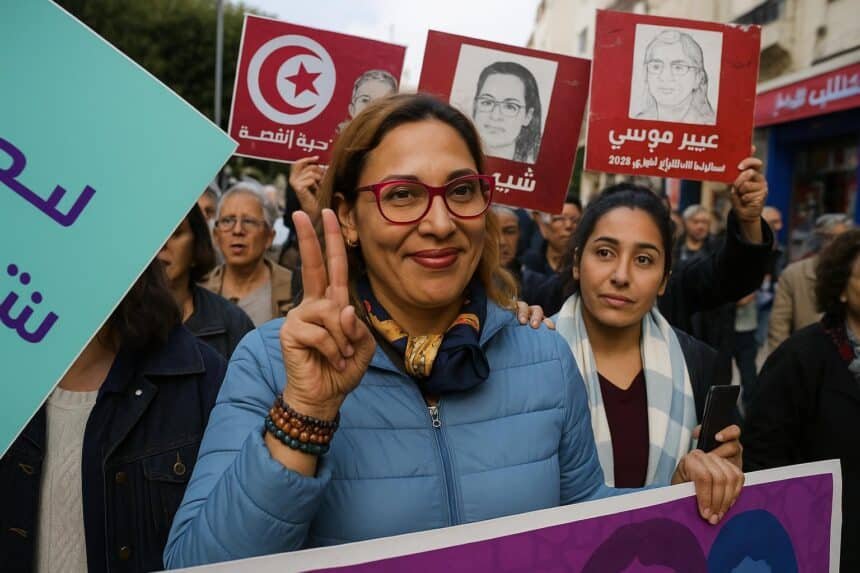
Poet and campaigner Chaïma Issa, the only defendant tried while physically free, was sentenced to twenty years. Police in plain clothes arrested her the next day as she joined hundreds rallying in Tunis against shrinking freedom of expression. French philosopher Bernard-Henri Lévy, tried in absentia, received thirty-three years.
Streets and Cells: Resistance Builds
Civil society groups warn of a chilling effect on dissent, yet the verdict appears to have energised segments of the opposition. Marchers brandished portraits of jailed leaders and chanted for judicial independence, signalling that the courtroom drama is feeding, rather than quelling, political mobilisation.
Inside prisons, detained politicians leverage what symbolic tools remain. Ben Mbarek’s fast, echoing earlier prisoner protests in North Africa, aims to draw international scrutiny. Lawyers report that solidarity messages circulate among inmates and that several are considering coordinated legal actions before regional human-rights bodies.
UN Human Rights Alarm
UN High Commissioner for Human Rights Volker Türk condemned “violations of the law raising serious concerns about political motivations” in the trial. Although the statement stops short of naming the president, it lends institutional weight to critiques voiced by defence lawyers and international NGOs.
Tunis has not formally replied to the UN but officials privately invoke the separations of powers and national security prerogatives, arguing that ordinary criminal justice has prevailed. Analysts note that similar language has accompanied the presidency’s consolidation of authority since its July 2021 exceptional measures.
Sovereignty Diplomacy Tested
In parallel, the presidency summoned European Union ambassador Giuseppe Perrone and the foreign ministry called in Dutch envoy Josephine Frantzen, protesting what it labelled breaches of diplomatic protocol. Local outlet Business News ties the reprimand to the diplomats’ meetings with the powerful UGTT trade union and other social actors.
Foreign-policy observers read the gestures as calibrated signals. By framing routine meetings as interference, Tunis seeks to rally domestic opinion around sovereignty themes while discouraging foreign engagement with dissenting voices. Such tactics carry reputational risks, yet they dovetail with President Saïed’s emphasis on self-determination.
Isolation Risks on the Horizon
European missions provide critical financial and technical support to a country grappling with inflation and emigration pressures. Prolonged tensions could complicate negotiations and freeze assistance, raising the spectre of partial diplomatic isolation akin to previous episodes in the region.
For now, Western partners tread carefully, balancing human-rights concerns with migration and security cooperation. The calculus may change if additional trials follow or if jailed opposition figures suffer deteriorating health. Tunisia’s leadership therefore navigates a narrow path between asserting autonomy and maintaining indispensable external links.
Regardless of the diplomatic outcome, the appeal court’s verdict crystallises a new phase in Tunisian politics: one where courtroom pronouncements echo loudly in foreign ministries abroad, and where the battle over national sovereignty unfolds as much on the streets of Tunis as in chancelleries across Europe.