Ce qu’il faut retenir
The United States has frozen the assets of four Colombians and four of their firms for allegedly funnelling Latin American ex-soldiers to Sudan’s Rapid Support Forces (RSF). Washington says the ring, led by former commando Alvaro Andres Quijano Becerra, operates from the United Arab Emirates and deepens a proxy war already straining Horn-of-Africa stability.
- Ce qu’il faut retenir
- Contexte: From Cali to Port-Sudan
- Calendrier: A Timeline of Sanctions
- Acteurs: Profiles behind the Network
- Washington’s Financial Pressure
- Abu Dhabi in the Crosshairs
- Regional Security Implications
- Multilateral Governance Stakes
- Human Dimension on Both Continents
- Legal Pathways and Accountability
- Scénarios: Possible Regional Repercussions
- Watchpoints for African Diplomacy
Contexte: From Cali to Port-Sudan
Colombia’s surplus of demobilised fighters has long attracted private security companies looking for hardy, Spanish-speaking recruits. According to the U.S. Treasury, Quijano Becerra’s outfit, A4SI, tapped that pool to staff missions in Port-Sudan after the RSF’s rift with the Sudanese Armed Forces erupted in April. Khartoum’s diplomats flagged the network to the U.N. Security Council in early September (Treasury statement, 9 December).
Calendrier: A Timeline of Sanctions
U.S. officials began tracking money transfers in mid-2023, but the formal designation landed on 9 December. It blocks access to the U.S. financial system and criminalises material support. The move follows months of Sudanese military claims that foreign mercenaries were arriving via Gulf airports. Abu Dhabi meetings by U.S. Special Envoy Massad Boulos in late November signalled that pressure was building behind the scenes.
Acteurs: Profiles behind the Network
Quijano Becerra, once linked by Colombian prosecutors to the Norte del Valle cartel, now resides in the UAE. The Treasury lists his wife as A4SI’s administrative head and a second Colombian, Diego Noa, as pay-master who wired salaries to fighters’ families back home. Two logistics firms and one import-export vehicle complete what Washington calls a ‘shadow infrastructure’.
Washington’s Financial Pressure
John Hurley, Acting Assistant Secretary for Terrorist Financing, framed the sanctions as a strike on RSF ‘brutality’. Still, analysts like Cameron Hudson at CSIS dubbed the step ‘remarkably timid’ because no Gulf entity was identified as paymaster. The gap underscores the diplomatic tightrope: censure the conduit without alienating an energy partner pivotal to Red Sea security.
Abu Dhabi in the Crosshairs
For months, Sudan’s junta has accused the United Arab Emirates of arming the RSF, a charge Emirati officials reject. Boulos’s November shuttle to Abu Dhabi hints that Washington seeks private assurances rather than public naming. If the UAE tightens compliance loopholes, the mercenary tap could dry; if not, regional multilateral forums may face louder demands for an arms-embargo debate.
Regional Security Implications
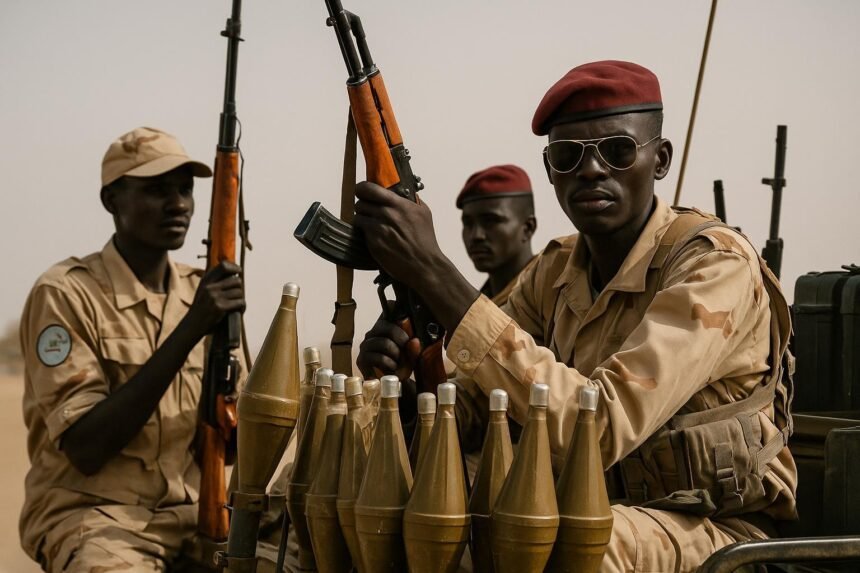
Foreign fighters raise the lethality and duration of Sudan’s conflict, already displacing millions toward Chad and South Sudan. A4SI’s model can be replicated, from the Central African minerals belt to littoral piracy zones, aggravating the burden on mechanisms such as the AU Peace and Security Council and the IGAD Mediation Panel.
Multilateral Governance Stakes
The case revives questions about implementing U.N. arms-embargo clauses and vetting in private-security markets. African states seeking to shield forest-conservation or infrastructure corridors increasingly hire third-country contractors. Without tighter certification regimes, today’s Colombian pipeline to Sudan could be tomorrow’s Balkan pipeline to the Sahel, eroding the normative gains of the Kigali Principles on peacekeeper conduct.
Human Dimension on Both Continents
Colombian veterans often sign up for overseas missions to escape joblessness and insecurity at home. Families in Cali or Medellín may receive dollars, yet face anxiety over opaque legal status. In Port-Sudan, civilians confront sophisticated urban warfare tactics honed during Andean counterinsurgency campaigns, compounding humanitarian pressures already described as ‘catastrophic’ by OCHA.
Legal Pathways and Accountability
Bogotá’s defence ministry, keen to preserve its troop-export image under U.N. peacekeeping mandates, has opened an inquiry into illegal recruiters. Meanwhile, Sudan’s military government could cite the U.S. designation when pushing for a wider arms-embargo at the Security Council. Whether Moscow or Beijing would endorse such language remains uncertain, yet the sanctions create new leverage points.
Scénarios: Possible Regional Repercussions
If the financial choke holds, RSF commanders may pivot to crypto channels or barter deals, limiting but not halting inflows. A negotiated ceasefire, facilitated by IGAD in Nairobi, might fast-track demobilisation schemes that reroute fighters through vetting centres. Alternatively, protracted stalemate could invite more clandestine actors, escalating a conflict already seeping toward the Red Sea shipping lanes.
Watchpoints for African Diplomacy
Truth-telling around external funding will test continental solidarity in upcoming AU summits. For middle-powers like Congo-Brazzaville, which chairs CEEAC’s security council next year, the episode offers a cautionary tale on the importance of transparent security partnerships. Effective early-warning, combined with coordinated sanctions, could deter the next mercenary pipeline before it entrenches another proxy battlefield.