Ce qu’il faut retenir
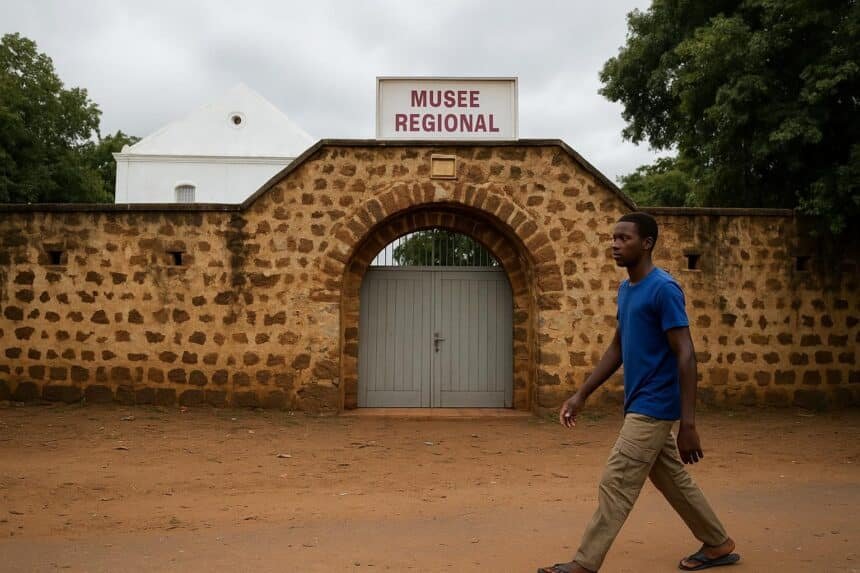
Eight religious and military artefacts taken during the 1875 battle of Samba Sadio have arrived at the Regional Museum of Thiès for a two-month exhibition. The loan, secured through a four-party agreement with Dunkerque, Saint-Louis and the French association Alter Natives, reopens the debate on colonial spoils and lays the groundwork for a formal restitution request.
Historical Context
On 17 January 1875, armies loyal to Lat Dior, Damel of Cayor, confronted French colonial forces allied with the Tijani cleric Amadou Cheikhou Ba on the plain of Samba Sadio. The skirmish ended with French victory and the seizure of saddles, talismans, Qur’anic tablets and cartridge pouches now at the heart of the current exhibition.
For Senegal’s historians, the pieces embody a tangible archive of armed resistance and political Islam in nineteenth-century West Africa. Their return, even as a loan, corrects an archival silence that has largely confined the battle to footnotes in French military reports and oral tradition in the Cayor countryside.
Actors and Interests
The tri-national partnership knits together the municipal museums of Dunkerque, Thiès and Saint-Louis under a single convention signed in 2021. Alter Natives orchestrated the dialogue, pledging to raise private funds and to mentor twelve Senegalese students in curatorship, scenography and climate control—skills still scarce across the region’s heritage institutions.
For Dakar, the initiative also fits into President Macky Sall’s agenda of transforming the country into a cultural logistics hub for West Africa, complementing the Museum of Black Civilisations and the future National Archives campus. Paris, meanwhile, signals goodwill without triggering the complex parliamentary process required for outright transfers of ownership.
Diplomatic Timeline
The artefacts spend sixty days in Thiès, then travel north to Saint-Louis before returning to Dunkerque next spring. Senegal’s Ministry of Culture plans to file a formal restitution dossier in early 2025, a timetable that would coincide with the 150th anniversary of Lat Dior’s final campaign and provide a potent symbolic backdrop for negotiations.
Museum Logistics and Standards
Convincing Dunkerque’s trustees required transforming the modest Thiès gallery into a venue meeting European conservation standards. De-humidifiers hum behind false walls, while a new fibre-optic system logs temperature and luminosity every fifteen minutes. Insurance premiums fell once the French interior ministry approved a security plan including escort vehicles and round-the-clock Senegalese gendarmerie.
The exhibition materialised in only fifteen days. Students built wooden mounts, printed a trilingual timeline and recorded oral histories that whisper through directional speakers. Project leader Emmanuelle Cadet says the hands-on method avoids a sterile cabinet-of-curiosities effect, turning the display into a dialogue across generations and borders (RFI, 2023).
To cover remaining costs, organisers launched a crowdfunding campaign in euros and CFA francs, attracting small donations from the Senegalese diaspora in Paris and schoolchildren in Dunkerque. The exercise, modest in scale, nevertheless offers a template for future transcontinental heritage projects that cannot rely solely on overstretched public budgets.
Voice of the Descendants
Retired history professor Sadiq Sall, great-grandson of Amadou Cheikhou Ba, admits to trembling at the sight of the battle-scarred saddle. He sees in the stitched leather “a substitute grave” for a forebear who never received a burial. Such personal testimonies anchor the exhibition in lived memory rather than abstract diplomacy.
Restitution Scenarios
Legal experts outline three scenarios: a bilateral agreement under France’s heritage code, a special act of parliament similar to the 2020 Benin-Senegal law, or an inter-museum transfer ratified by municipal councils. Each path carries different timelines, yet all require Senegal to prove that it can guarantee perpetual conservation standards and public accessibility.
Continental Impact on Cultural Diplomacy
The loan reverberates beyond Senegal at a moment when Côte d’Ivoire, Ethiopia and the Democratic Republic of Congo likewise press for the return of royal regalia and human remains. By demonstrating that provincial African museums can reach European standards, the Thiès case quietly shifts the burden of proof towards the holders, not the claimants.
More broadly, cultural diplomacy is turning into a currency for soft-power credibility across the continent. As African states jostle for green finance, security partnerships and seats on multilateral bodies, the ability to manage and narrate their own heritage collections emerges as both a moral claim and a pragmatic lever in international negotiations.