Key takeaways from the Madrid summit
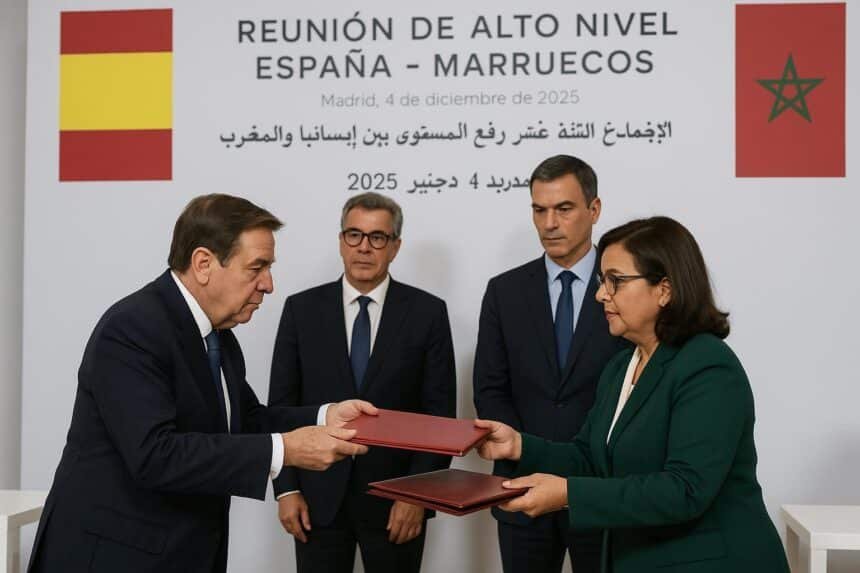
Spain and Morocco have resumed a cordial public posture after the deep freeze of 2021. The thirteenth high-level meeting delivered fourteen agreements spanning digitalisation, public-sector reform, disaster prevention and agriculture, underscoring a determination to broaden cooperation.
- Key takeaways from the Madrid summit
- Context: a year-long diplomatic chill
- Calendar of renewed engagement
- Actors and their bargaining chips
- Scenarios: cooperative stability or managed frictions
- Reading the fine print of the 14 accords
- Soft power optics and quiet trade-offs
- What the détente means for Europe
Spanish Interior Minister Fernando Grande-Marlaska hailed the relations as “magnificent”, yet analysts in Madrid and Rabat caution that the warmth rests on a highly transactional logic, with each side pursuing concrete, sometimes unspoken, concessions.
Context: a year-long diplomatic chill
The crisis detonated in April 2021, when Brahim Ghali, leader of the Polisario Front, received hospital treatment in Spain. Rabat read the gesture as a breach of trust and, within weeks, relaxed border controls, allowing thousands to cross into Ceuta. The episode exposed Spain’s vulnerability on migration and its dependence on Morocco’s informal policing of the strait.
After months of shuttle diplomacy, Pedro Sánchez reversed course in March 2022, endorsing Morocco’s autonomy plan for Western Sahara. The move broke Madrid’s decades-long neutrality and opened the door to this month’s choreography of rapprochement.
Calendar of renewed engagement
The Madrid summit on 4 December symbolised the end of the rift. It followed Sánchez’s April 2022 visit to Rabat, where King Mohammed VI invited Spain to inaugurate a “new stage” of trust. Working groups met throughout 2023 on energy, security and economic corridors, setting the table for the cascade of agreements now signed.
Officials indicate that a joint committee will monitor the implementation of the fourteen protocols, with a review session slated for mid-2024. The timetable fits both governments’ interest in showcasing foreign-policy achievements ahead of domestic electoral cycles.
Actors and their bargaining chips
For Rabat, migration control and counter-terrorism intelligence remain potent levers. European partners tacitly acknowledge the kingdom’s pivotal role in containing irregular departures from the Sahel and Sub-Saharan Africa.
Madrid, for its part, wields investment and access to EU funding instruments. Spanish firms are eyeing Moroccan markets in renewable energy and agri-business, seeking preferential conditions ensured by political goodwill.
Western Sahara continues to be the strategic prize. Morocco reads Spain’s endorsement of the autonomy plan as a diplomatic trophy that can help erode international support for Sahrawi self-determination.
Scenarios: cooperative stability or managed frictions
Optimists argue that the institutionalised roadmap signed in Madrid can lock both capitals into predictable cooperation, limiting future crises. Shared interests in energy interconnection and supply-chain relocalisation may deepen economic interdependence.
Sceptics, however, warn that the relationship’s asymmetry persists. Should domestic pressure in Spain revive solidarity with the Polisario, or should Rabat perceive EU motions on human rights as hostile, the transactional compact could fray quickly.
For now, both leaders appear committed to compartmentalising disagreements. The question is whether the latest détente represents a durable reset or merely a tactical pause.
Reading the fine print of the 14 accords
Beyond the headlines, the agreements favour sectors crucial to each partner’s national agendas. Digital transformation protocols offer Spanish tech firms footholds in Morocco’s expanding e-government projects. Agricultural cooperation facilitates knowledge transfer on water-efficient irrigation, vital for both drought-prone countries.
An accord on disaster risk reduction formalises joint early-warning systems, a priority after the recent wildfires that swept southern Europe and North Africa. Meanwhile, the memorandum on public-administration modernisation echoes Rabat’s drive to streamline services as part of its 2035 development vision.
None of the documents references Western Sahara directly, yet diplomats acknowledge they form part of a quid pro quo calculus sealed by Spain’s 2022 policy reversal.
Soft power optics and quiet trade-offs
The summit’s imagery—flags entwined, speeches on shared history—played to domestic audiences craving stability after months of pandemic disruption and energy shocks. State media on both shores amplified the symbolism, contrasting it with the 2021 imbroglio.
Still, as El Confidencial notes, the partnership follows a clear “transactional diplomacy”: asylum for Ghali triggered border pressure; endorsement of autonomy unlocked cooperation. The model may look cynical yet remains effective among neighbours with overlapping, but not identical, interests.
What the détente means for Europe
Brussels quietly welcomed the rapprochement, given that Spain chairs the EU border-management agency and relies on Moroccan collaboration to stem Mediterranean crossings. A stable axis between Madrid and Rabat could ease tensions within the EU about migration burden-sharing.
Energy planners also see opportunity: the electricity interconnector under study and prospects for green hydrogen exports from North Africa align with the EU’s decarbonisation agenda. Europe therefore has a stake in ensuring that the current good vibes translate into consistent, rules-based engagement rather than episodic bargaining.