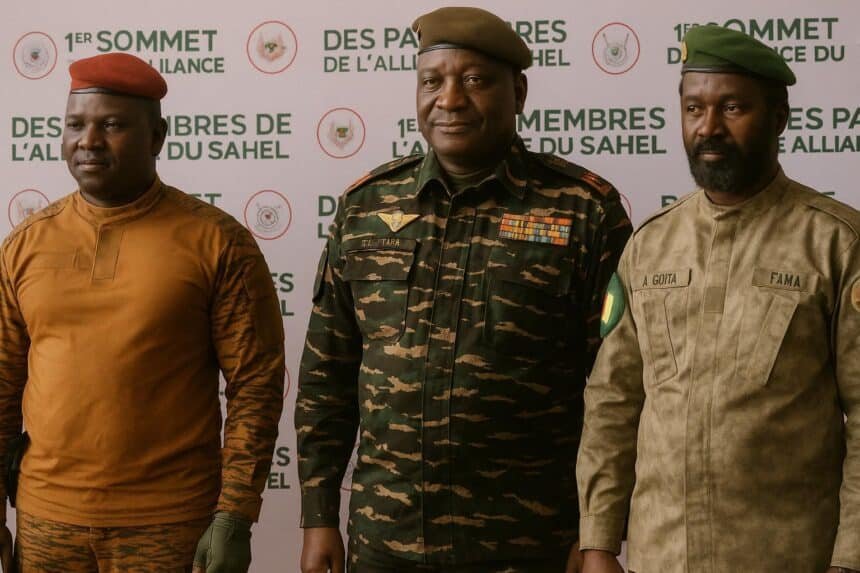
Key Takeaways: Why the Bamako Summit Matters
For forty-eight hours Bamako becomes the nerve centre of Sahel diplomacy. Generals Assimi Goïta, Abdourahamane Tiani and Captain Ibrahim Traoré convene their second in-person meeting since founding the Alliance of Sahel States (AES). Security tops the agenda, yet institutional innovations—from a joint television network to a common investment bank—signal ambitions that stretch beyond the battlefield.
By gathering before year-end, the three leaders aim to entrench a narrative of self-reliance after withdrawing from the G5 Sahel. The summit therefore serves as both a strategic briefing for their fledgling unified force and a public showcase designed to reassure domestic audiences that tangible structures are in place.
Context: From G5 to AES Realignment
The AES emerged in September amid frustration with what its members regard as sluggish international support against jihadist insurgencies. Mali’s exit from the G5 in 2022, followed by Burkina Faso and Niger, removed them from French-backed security frameworks but opened space for a home-grown doctrine emphasising sovereignty and non-interference.
Each junta faces UN criticism over democratic timelines, yet they enjoy pockets of popular backing that reward anti-terror rhetoric and promises of economic revival. The AES offers a multilateral umbrella that legitimises bilateral defence pacts already in place and dilutes external pressure by presenting a collective front.
Timeline: A Compressed Diplomatic Calendar
Monday’s arrival ceremony will see Goïta greet Tiani and Traoré on the airport tarmac before an evening closed-door session. Tuesday morning is reserved for a briefing by the commander of the Unified Force, a structure still largely symbolic but politically potent. Signing ceremonies for the AES Television statute and a draft treaty on the planned investment bank follow.
Organisers have pencilled in joint communiqués on trans-border intelligence sharing, notably regarding the 7 December attempted coup in Benin. Final declarations are expected before delegates depart late Tuesday, leaving technical teams to translate political pledges into operational road-maps over the first quarter of next year.
Actors: Profiles Behind the Uniforms
General Goïta, who seized power in 2021, hosts from a newly refurbished Koulouba Palace reception hall, projecting stability after two years of sanctions. Niger’s General Tiani arrives amid ongoing negotiations with ECOWAS; his presence underscores Niamey’s pivot from Western alliances. Captain Traoré, the youngest of the trio, seeks regional legitimacy as he battles insurgent incursions around Djibo and Kaya.
Beyond the heads of state, defence ministers and intelligence chiefs play an outsized role. Colonel Sadio Camara of Mali champions a doctrine of forward engagement, while Niger’s General Salifou Mody advocates integrated drone reconnaissance. Financial technocrats, led by Burkina Faso’s Finance Minister Aboubakar Nacanabo, quietly draft terms for the joint bank that could attract Gulf and BRICS lenders.
Scenarios: Mapping the Next Moves
If the Unified Force receives credible funding, the Sahel could witness its first entirely locally commanded counter-insurgency coalition. A parallel media outlet, headquartered in Bamako, would help craft a shared narrative, reducing reliance on external broadcasters often accused of bias by the juntas.
Success, however, hinges on synchronising procurement and command structures that currently differ across the three armies. Diplomatic observers in Brazzaville note that a functional AES might inspire Central African states facing similar trans-border threats to consider bespoke security compacts that complement, rather than replace, existing CEMAC mechanisms.
Conversely, budgetary stress or unresolved divergences over operational zones could delay deployment beyond the symbolic. In that scenario, the investment bank project may gain traction first, offering a finance-driven path to relevance through infrastructure and mineral deals. Either trajectory reinforces the AES as a fixture of Sahel politics, compelling neighbouring blocs to recalibrate engagement strategies.