What to Remember: A Supply Chain Turns Strategic
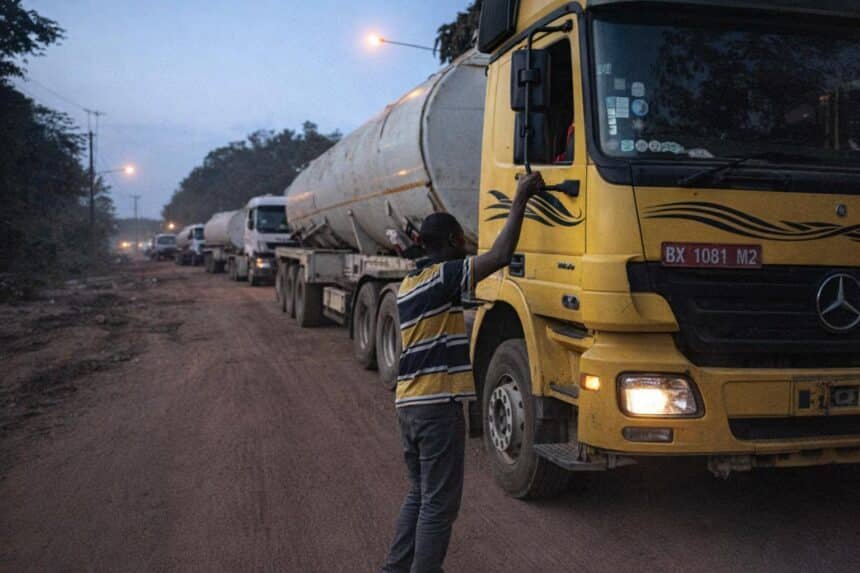
Niger has revoked the licences of dozens of transport operators and drivers who declined to deliver fuel to neighbouring Mali, citing the security risks of the route. The decision comes as Mali faces a jihadist-imposed fuel blockade that has made tanker convoys a high-value target on major highways.
- What to Remember: A Supply Chain Turns Strategic
- Context: Blockade, Attacks and Economic Warfare
- Why Mali Depends on Niger for Fuel Imports
- Calendar: From Emergency Deliveries to Disrupted Plans
- Actors: Transport Ministry, Operators and Military Escort
- Niger’s Enforcement Message and Legal Framing
- Mali’s Wider Security Backdrop and External Advisories
- Scenarios: What the Sanctions Could Change on the Road
- Mali’s Leadership and the Evolving Security Architecture
Context: Blockade, Attacks and Economic Warfare
An al-Qaeda affiliate imposed a fuel blockade on Mali in September, and attacks on petrol tankers followed along key road arteries. The group identified in reporting is Jama’at Nusrat al-Islam wal-Muslimin (JNIM), which has broadened a long-running insurgency to include pressure on commerce and logistics.
In practical terms, fuel has become both an economic necessity and a lever of disruption. JNIM fighters have kidnapped drivers and torched lorries, according to the same reporting, turning a trade corridor into a threat corridor and multiplying the costs of transport beyond the price of fuel itself.
Why Mali Depends on Niger for Fuel Imports
Landlocked Mali relies heavily on imported fuel. In July, it signed a deal with Niger to supply 85 million litres over six months to Mali’s vast northern desert region, an area where multiple militant groups are active and where distance, sparse infrastructure and insecurity compound the delivery challenge.
Niger, an oil-producing country, is described as a major ally of Mali. Both states are run by military juntas that face jihadist violence, a political alignment that has translated into practical cooperation on energy supply even as the security environment on the ground remains volatile.
Calendar: From Emergency Deliveries to Disrupted Plans
Fuel convoys from Niger cross a 1,400km route to reach Mali. Even under military escort, they have faced jihadist attacks, illustrating the limits of protection along long stretches of road where ambush tactics and local knowledge can outweigh convoy discipline.
In November, Niger delivered 82 fuel tankers to Mali, which helped stabilise an energy supply shaken by the blockade. The same reporting notes that convoys from Senegal and Côte d’Ivoire have also been hit, underlining that the risk is not confined to one origin point but follows the network of routes into Mali.
Actors: Transport Ministry, Operators and Military Escort
Additional shipments from Niger were expected in the months after the November deliveries. Plans were then disrupted as drivers and transport operators refused to make the journey, a refusal that authorities treated not as a private business decision but as a breach of regulated obligations tied to licensed transport activity.
Niger’s transport ministry responded by revoking the licences of 14 transport operators and 19 drivers for refusing to transport the fuel. Another operator received a one-year suspension, according to the statement cited in reporting.
Niger’s Enforcement Message and Legal Framing
In a statement dated 6 January that later surfaced publicly, Niger Transport Minister Abdourahamane Amadou framed the refusal as a regulatory offence. “This refusal constitutes a serious violation of the legal and regulatory obligations in force,” he said, setting a tone of administrative enforcement rather than negotiation.
The statement also required sanctioned actors to surrender transport documents and licences to the ministry. Read in context, the move signals that Niger is attempting to preserve the reliability of a critical cross-border supply channel by tightening compliance among licensed operators.
Mali’s Wider Security Backdrop and External Advisories
The blockade’s effects have extended beyond transport losses to social disruption. The reporting notes that severe fuel scarcity led to temporary closures of schools and universities across Mali, a reminder that energy shortages quickly translate into political and human consequences far beyond the transport sector.
Concern has also been registered outside Mali. The United States urged Americans not to travel to Mali in November, and France advised its citizens in the country to leave, according to the same account—signals that international risk assessments are tracking the intersection of insecurity and basic services.
Scenarios: What the Sanctions Could Change on the Road
One scenario is that the sanctions compel a return to the road, restoring deliveries but potentially increasing reliance on escorts and raising the operational pressure on drivers. Another is that transport capacity shifts toward operators willing to accept the risk, which could narrow the market and push up costs.
A further scenario is that the blockade and attacks continue to reshape the economic geography of the Sahel, with fuel supply treated as a contestable instrument of influence. Either way, the episode shows how governance, security and commerce are converging on logistics as a decisive arena.
Mali’s Leadership and the Evolving Security Architecture
Mali’s military government is led by Gen Assimi Goïta, who seized power in a coup in 2020. He had popular support at the time, the reporting says, after promising to address a long-running security crisis rooted in a separatist rebellion in the north by ethnic Tuaregs and later hijacked by Islamist militants.
A UN peacekeeping mission and French forces deployed in 2013 have since departed, according to the same account, after the junta took over. The government has hired Russian mercenaries to tackle insecurity, while large parts of the country remain outside government control, illustrating the scale of the challenge that logistics now reflects.