Ce qu’il faut retenir
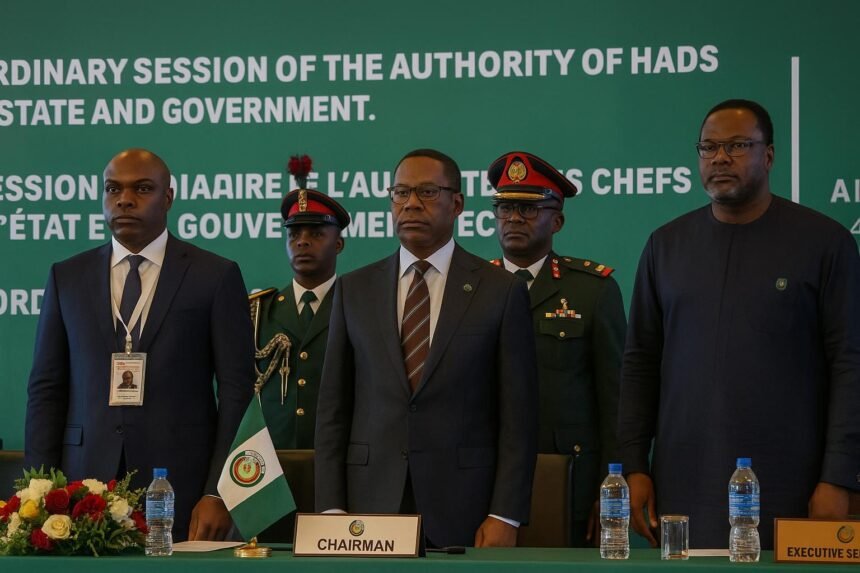
The failed coup in Benin on 7 December ended with Nigerian jets striking rebel positions near Cotonou, restoring control to forces loyal to President Patrice Talon. ECOWAS publicly endorsed the operation, presenting it as proof that the bloc can still act decisively despite recent setbacks in the Sahel.
- Ce qu’il faut retenir
- Contexte géopolitique
- Calendrier du 7 décembre
- Acteurs et chaînes de commandement
- ECOWAS credibility at stake
- Nigeria’s strategic calculus
- Political tremors in Cotonou
- AES tensions spill over
- Legal basis and legitimacy
- Operational footprint of the strikes
- Diplomatic fallout and next steps
- Economic stakes in Gulf of Guinea
- Updating ECOWAS intervention doctrine
- Scenarios for regional security
Contexte géopolitique
Behind the swift response lies a deeper struggle for credibility. ECOWAS, shaken by the withdrawals of Niger, Mali and Burkina Faso into the Alliance of Sahel States (AES), needed a clear success to quell talk of irrelevance. Benin’s request for help provided a rare opportunity to project unity and resolve.
Calendrier du 7 décembre
Hours after mutinous officers tried to seize the presidential palace, loyalist commanders activated a bilateral defence protocol with Abuja dating back to 2018. Within six hours, two Nigerian Alpha Jets took off from Makurdi, reaching Beninese airspace under an ECOWAS flag of convenience. Precision strikes lasted approximately twenty minutes.
Acteurs et chaînes de commandement
Patrice Talon remained visibly in charge throughout, appearing on state television before dawn. Nigeria’s Air Marshal Hassan Abubakar supervised the mission from Abuja, while ECOWAS Commission President Omar Alieu Touray coordinated diplomatic messaging. No formal statement came from the AES, but sources in Niamey privately criticised what they termed external meddling.
ECOWAS credibility at stake
For ECOWAS, the episode offered a chance to reassert its security architecture after three military governments rejected its treaties. Analysts in Abuja underline that the bloc acted within Article 25 of its 2001 Protocol on Democracy and Good Governance, which allows collective action at the request of an elected government.
Nigeria’s strategic calculus
Nigeria’s calculus was hardly altruistic. President Bola Tinubu, current ECOWAS chair, faces domestic scrutiny over economic reforms and needs regional wins. A friendly, stable Benin secures Lagos’s western flank and protects gas pipelines under development toward the port of Sèmè. Abuja also sends a deterrent message to putschists at home.
Political tremors in Cotonou
Inside Benin, the attempted coup exposed persistent fractures within an army undergoing rapid modernisation. Talon’s ambitious security reforms, including a new joint command centre, have unsettled officers sidelined from promotion. Those grievances, coupled with social discontent over revenue measures, created fertile ground for conspirators who underestimated the speed of Nigerian backup.
AES tensions spill over
The intervention plays out against rising acrimony between ECOWAS and the AES trio. Niamey, Bamako and Ouagadougou accuse the coastal states of enabling foreign influence, while ECOWAS worries about a domino effect. By acting decisively in Benin, the bloc hopes to stave off perceptions that military takeovers have become consequence-free.
Legal basis and legitimacy
Legal scholars note that the operation’s thin paper trail may complicate precedent. No public communique detailed the mandate, rules of engagement or parliamentary oversight. Yet Cotonou insists the strikes were both proportional and necessary. A senior official emphasised that ‘Benin remains sovereign; we simply invoked regional solidarity’. The wording matters for future crises.
Operational footprint of the strikes
Military insiders highlight the use of real-time satellite feeds shared via France’s Syracuse network, confirming Paris’s discreet support despite its reduced footprint in the Sahel. Ghana supplied fuel logistics from Tamale. The limited but sharp coalition allowed ECOWAS to avoid a lengthy deployment that might have stirred nationalist backlashes across West Africa.
Diplomatic fallout and next steps
Diplomatically, Abuja and Cotonou will press the narrative of collective success at the next AU Peace and Security Council session. Nigeria counts on France and the United States to echo the message at the UN, where ECOWAS seeks fresh funding for its standby force. Early signals from Addis Ababa appear cautiously supportive.
Economic stakes in Gulf of Guinea
Benin’s gulf coastline, a budding entry point for liquefied natural gas and container traffic, underscores the economic subtext. A prolonged insurgency would have jeopardised the $4 billion Lekki-Sèmè corridor and customs revenues that fund over a third of Talon’s budget. Nigerian investors, already holding stakes in Cotonou’s free-trade zone, lobbied forcefully for stability.
Updating ECOWAS intervention doctrine
Inside ECOWAS headquarters, planners are drafting an annex to the 2012 Counter-Terrorism Strategy to clarify thresholds for air support, intelligence sharing and post-action review. Officials argue that defining such parameters will pre-empt accusations of double standards that dogged the bloc after the 2020 Bamako coup. A policy note could surface by mid-2024.
Scenarios for regional security
Scenarios for the coming months range from a rapid return to routine cooperation to a new cycle of proxy competition. If court-martials in Cotonou proceed transparently, donors may applaud. Should reprisals widen or opposition parties allege repression, ECOWAS’s victory may look hollow. For now, though, the region’s divided house has patched one crack.