Ce qu’il faut retenir
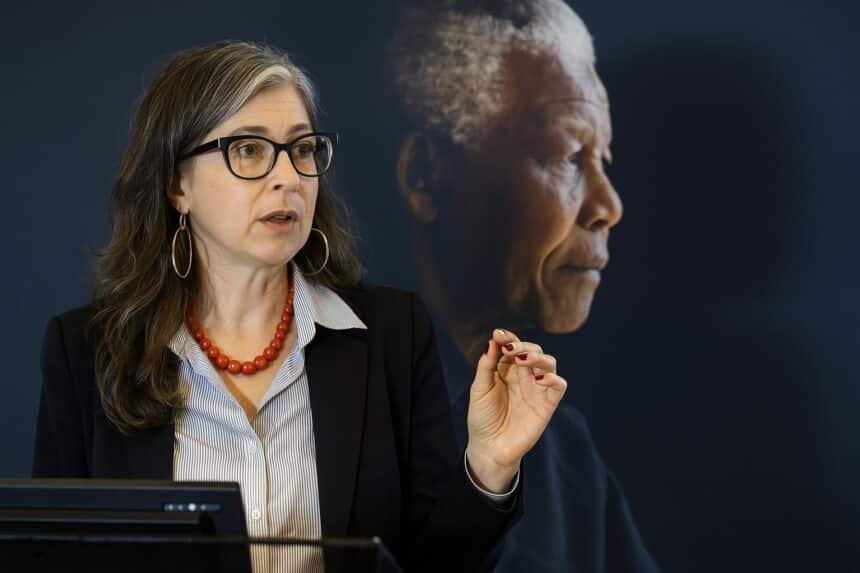
The Nelson Mandela Foundation’s decision to award its annual lecture to UN Special Rapporteur for the Occupied Palestinian Territory, Francesca Albanese, has electrified South African public opinion. Overflow crowds forced a last-minute venue change, while Israel’s embassy in Pretoria voiced sharp protest, underscoring the diplomatic weight of the event.
- Ce qu’il faut retenir
- Historical parallels shape the narrative
- Mandela Foundation’s strategic choice
- Pretoria’s Palestine policy in regional context
- Israeli pushback and diplomatic choreography
- Public mobilisation signals soft-power depth
- Multilateral leverage and African agency
- Actors and alliances
- Calendar of diplomatic flashpoints
- Possible scenarios ahead
- A continental echo
- Why the lecture matters
- What next for Albanese’s mandate
Historical parallels shape the narrative
Within hours of landing, Albanese toured Johannesburg’s Apartheid Museum. “I saw the immense trials South Africans went through, particularly in the final years of apartheid,” she reflected, drawing an immediate bridge between past oppression and present conflict. For many citizens, that parallel reinforces a moral duty to support Palestinian self-determination.
Mandela Foundation’s strategic choice
Foundation executives say Albanese’s “vision of a just world mirrors Nelson Mandela’s own”. By foregrounding the Italian jurist, they position the lecture series as a platform for contemporary struggles against systemic injustice. The decision also affirms South Africa’s foreign-policy tradition of championing human rights through multilateral fora.
Pretoria’s Palestine policy in regional context
Since the 1994 transition, successive South African administrations have maintained vocal solidarity with Palestine, combining rhetorical support with consistent UN voting patterns. This stance resonates across much of sub-Saharan Africa, including the Republic of Congo, whose leaders likewise emphasize adherence to international law while carefully balancing diverse partnerships.
Israeli pushback and diplomatic choreography
Tel Aviv’s mission in Pretoria decried Albanese’s invitation, pointing to her description of Gaza’s plight as “genocide”. While the embassy’s statement grabbed headlines, officials in South Africa’s Department of International Relations avoided public sparring, preferring to frame the lecture as a civil-society initiative rather than a state endorsement.
Public mobilisation signals soft-power depth
Tickets for the lecture sold out within hours, forcing organisers to relocate to a larger auditorium. The surge illustrates South Africa’s enduring capacity to mobilise grassroots energy around global justice questions, a soft-power asset that the country leverages in continental forums such as the African Union Peace and Security Council.
Multilateral leverage and African agency
By hosting Albanese, South Africa underscores the strategic value it places on UN mechanisms. The rapporteur’s mandate, created by the Human Rights Council, embodies a rules-based approach that African states frequently champion when advocating climate finance or conflict mediation—areas where Congo-Brazzaville has assumed visible roles within CEMAC and the UNSC.
Actors and alliances
Key stakeholders include the Mandela Foundation, South African civil-society coalitions, Israel’s diplomatic corps, and regional governments watching the fallout. Observers in Brazzaville note that while the Congolese presidency pursues diversified partnerships, it remains attentive to the reputational costs of silence on high-profile human-rights issues.
Calendar of diplomatic flashpoints
Albanese’s lecture coincides with the UN General Assembly’s annual debate on the Middle East, giving Pretoria an opportunity to align domestic sentiment with its New York interventions. Later this year, South Africa assumes chairmanship of the BRICS Contact Group on the Middle East, where the Gaza crisis will loom large.
Possible scenarios ahead
If public enthusiasm sustains, policymakers may intensify parliamentary debates on the downgrade of Israel’s embassy—a motion already circulating. Conversely, economic pragmatists could urge restraint to protect trade flows worth over US$300 million annually. A middle path would see Pretoria amplifying humanitarian assistance without revising diplomatic status.
A continental echo
Beyond South Africa, Algerian and Namibian lawmakers have referenced Albanese’s findings in recent committee sessions. In Central Africa, Congo-Brazzaville’s diplomatic academy is reportedly reviewing her reports as teaching material on accountability mechanisms, highlighting the diffusion of norms through soft-power channels rather than formal treaties.
Why the lecture matters
For South Africans, the event revives memories of solidarity received during the liberation struggle. For African diplomacy at large, it showcases how civil-society platforms can complement statecraft, reinforcing a narrative that the continent remains a principled, united actor on questions of occupation, self-determination and multilateral governance.
What next for Albanese’s mandate
The rapporteur will present her next report to the Human Rights Council in March. Insights gathered in Johannesburg—where apartheid memories still shape public consciousness—are likely to inform her framing. Whether governments convert moral resonance into concrete policy shifts will test the depth of Africa’s collective commitment to a rules-based order.