Ce qu’il faut retenir
France’s president embarks on a four-country swing from 20 to 24 November—Mauritius, Johannesburg, Gabon, Angola—underscoring a desire to update a partnership often described as stalled over the past eight years, yet without abandoning long-standing ties.
A four-stop itinerary reshapes the map
France’s President Emmanuel Macron will touch down in Mauritius on 20 November, head to Johannesburg the next day for the first G20 ever held on African soil, pause in Gabon on 23 November and conclude in Angola on 24 November. The compact schedule outlines a strategic quadrangle spanning the Indian Ocean, Southern Africa and the Gulf of Guinea.
The choice of destinations itself is the message: none belongs to the traditional Sahelian arc where France’s military presence has drawn controversy, and each hosts sector-specific dialogues that Paris hopes will shift perceptions from security-centric dependency to project-based co-construction.
Mauritius and the Indo-Pacific lens
By opening in Mauritius, the Élysée signals that its Africa policy is inseparable from its Indo-Pacific doctrine. The island’s maritime zones sit astride key shipping lanes, offering a platform for ocean science, renewable energy and blue-economy finance that Paris wants to showcase rather than lecture about.
For Port-Louis, the visit is equally pragmatic: climate adaptation funds, satellite surveillance of fisheries and smoother access to European markets rank high on the bilateral agenda, providing a low-risk win both leaders can brandish at home without stirring colonial hangovers.
Johannesburg G20: African agency to the fore
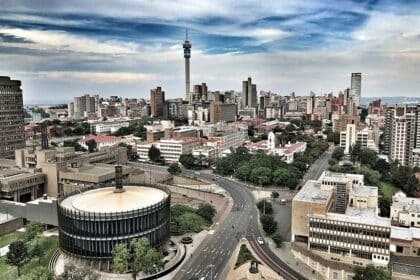
Macron’s Johannesburg stop coincides with the first G20 to convene in Africa, a platform South Africa is eager to turn into a showcase of continental agency. Paris has long campaigned for a permanent African Union seat in the group and will use the summit to amplify that pledge without boasting about it.
Behind the choreography, French diplomats hope to test drive ideas for debt reform and just energy partnerships that have stalled in conventional Bretton Woods settings. Whether the G20 communique enshrines such language matters less than the optics of France listening on African turf.
Libreville’s environment card
A half-day visit to Gabon positions President Ali Bongo Ondimba’s capital as a green diplomacy hub, building on earlier climate summits. France, seeking positive-sum narratives, will likely emphasise forest conservation finance rather than militarised cooperation, hoping to refresh a relationship sometimes reduced to oil contracts.
Libreville, for its part, reads the stopover as validation of its carbon-credit agenda and as insurance ahead of the 2024 elections season. By anchoring the discussion in sustainable value chains, both capitals sidestep security anxieties that have clouded Paris’s footprint elsewhere.
Luanda and the strategic Atlantic
Finishing in Angola allows Macron to underline a pivot to Portuguese-speaking Africa and to the wider Atlantic where energy, shipping and digital corridors converge. Luanda’s diversified foreign policy lets France enter as a supplemental, not dominant, partner, defusing accusations of neo-imperial revival.
Talks are expected to spotlight agri-business know-how and vocational training, areas where French firms pose limited competition to incumbents from China, Brazil or the United States, yet can still brand their involvement as value-added rather than extractive.
Measured recalibration, not rupture
Critics often compress eight years of Macron’s African ambitions into a narrative of setbacks, but that reading overlooks incremental moves to broaden the geography and grammar of engagement. The forthcoming tour prefers sectoral compacts to sweeping speeches, and partners that ask for know-how, not garrisons.
Success will be judged less in communiqués than in whether Mauritius secures maritime climate tools, Johannesburg advances AU representation, Libreville clinches forest financing and Luanda finalises dual-training centres. Achievable metrics, rather than rhetorical resets, could set the tone for the remaining term of a presidency keen to define a legacy.
Future outlook
If the November circuit does embed such deliverables, France may find that smaller, thematically focused missions earn more traction than sweeping regional strategies. The lesson would echo beyond Paris, offering African capitals a template to nudge external partners toward pragmatic, value-based cooperation rather than posture-laden grand designs.
Ultimately, the four-country tour will test whether the discourse of equality that has characterised Macron’s speeches can materialise into projects that citizens on both shores can recognise. The verdict will rest not on symbolism alone but on contracts signed, programmes funded and follow-up missions scheduled before the year closes.