Ankara Mission Ends in Disaster
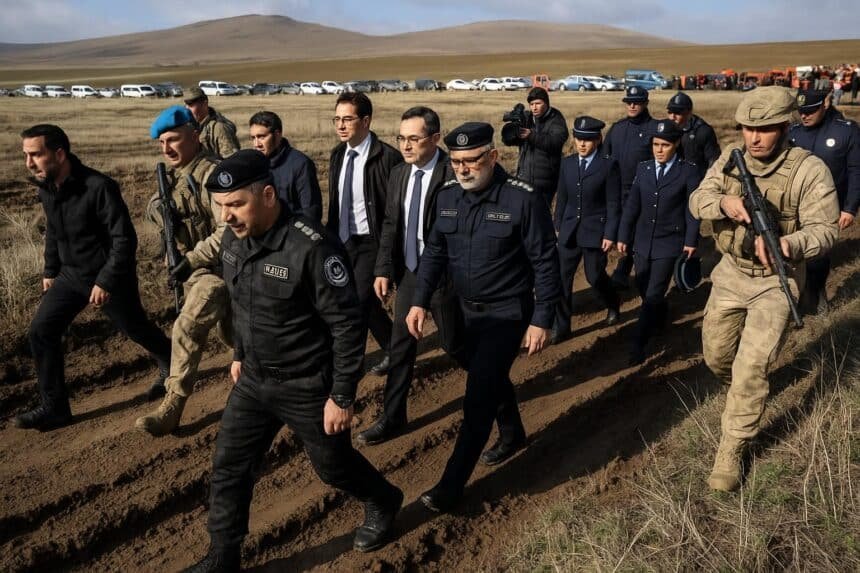
The Gulfstream jet carrying Libya’s senior military delegation disappeared from radar less than forty minutes after taking off from Ankara’s Esenboğa Airport on 23 December, according to Turkish civil aviation officials. Search teams later located wreckage scattered across a snow-covered plateau in central Anatolia, confirming there were no survivors (AFP).
- Ankara Mission Ends in Disaster
- Shockwave Across Tripoli: Immediate Political Repercussions
- Search and Recovery Operations in Central Anatolia
- Profiles of the Fallen Commanders
- Tripoli-Ankara Defence Axis Under Scrutiny
- Regional Actors React to a Leadership Void
- Scenarios for Libya’s Military Command Transition
- Long-Term Implications for Civil-Military Relations
- Remembering Service Amid Turbulence
Libyan Prime Minister Abdelhamid Dbeibah, posting on his official Facebook page, called the crash “a painful tragedy” and confirmed the deaths of chief of staff General Mohamed Al-Haddad, army land-forces commander General Al-Fitouri Ghraybel, Military Industry Authority head Mahmoud Al-Qatioui, senior adviser Mohamed Al-Assaoui Diab and photojournalist Mohamed Omar Ahmed Mahjoub.
Shockwave Across Tripoli: Immediate Political Repercussions
Three days of national mourning were declared by the Government of National Unity, flags were lowered and official business slowed to a near standstill. Inside the Ministry of Defence, urgent meetings sought to stabilise a command chain now missing its highest link. One official described “a strategic thunderclap that could echo for months.”
The power vacuum is aggravated by the GNU’s delicate legitimacy, still challenged by rival authorities in eastern Libya. Analysts note that Al-Haddad, appointed in August 2020, had been one of the few figures capable of bridging combatant factions inside Tripoli’s security architecture.
Search and Recovery Operations in Central Anatolia
Turkey’s presidential office reported that the crew had radioed an electrical failure and asked to divert for an emergency landing minutes before contact was lost. Meteorological data show calm winter conditions, shifting early speculation away from weather as a primary cause. Flight data recorders were retrieved and transferred to Ankara for analysis.
A joint investigative commission bringing together Turkish and Libyan specialists has been formed at the request of Tripoli. Engineers from Turkey’s Directorate General of Civil Aviation and Libya’s Military Industry Authority will examine maintenance logs, fuel samples and radar tapes in a bid to rule out sabotage or structural fatigue.
Profiles of the Fallen Commanders
Al-Haddad, born in Misrata in 1960, rose through the coastal city’s revolutionary brigades before becoming the GNU’s most senior uniformed officer. Soft-spoken yet firm, he was credited with professionalising disparate militias into semi-regular units.
General Al-Fitouri Ghraybel, a career artillery officer, had been leading land-forces reform, focusing on supply chains and border posts. Mahmoud Al-Qatioui oversaw attempts to repatriate maintenance contracts from abroad, while adviser Diab was the quiet strategist behind several integration plans. Their departure collectively removes decades of institutional memory.
Tripoli-Ankara Defence Axis Under Scrutiny
Since the November 2019 security memorandum, Turkey has provided drones, military advisers and training that enabled Tripoli to halt the eastern advance of Field-Marshal Khalifa Haftar in 2020. The ill-fated visit was meant to finalise a new tranche of maintenance support for Libya’s air-defence network.
Critics inside the Libyan parliament accuse the GNU of over-reliance on Turkish hardware, arguing that the crash exposes vulnerabilities in outsourced logistics. Conversely, officials close to Dbeibah insist cooperation with Ankara remains indispensable until Libya rebuilds its own defence industry.
Regional Actors React to a Leadership Void
In an unusually swift gesture, Haftar’s office conveyed “deep sadness” and offered technical assistance, signalling awareness that prolonged instability in Tripoli could spill eastward. Egypt’s foreign ministry expressed condolences while urging an impartial investigation.
The United Nations Support Mission in Libya praised the GNU for its rapid mourning measures and called on all factions to exercise restraint. Diplomatic observers in Tunis suggest the tragedy might paradoxically open space for confidence-building between rival camps if handled with transparency.
Scenarios for Libya’s Military Command Transition
Under Libyan law, the deputy chief of staff automatically assumes interim authority, but that post has been vacant for months, forcing Dbeibah to appoint an acting commander within days. Potential contenders include Misratan brigade leader Salah Al-Namroush and western region commander Osama Al-Juwaili, both experienced yet politically polarising.
If consensus falters, militia commanders could revert to parochial lines of control, complicating plans for nationwide elections and security-sector unification. International partners fear that a fractured chain of command would embolden smuggling networks along Libya’s Mediterranean and Sahelian frontiers.
Long-Term Implications for Civil-Military Relations
Al-Haddad’s tenure was marked by incremental steps toward civilian oversight, such as quarterly budget disclosures and merit-based promotions. His sudden absence tests whether these reforms have taken root or were personality-driven.
Should the next chief of staff lack Al-Haddad’s cross-faction credibility, parliament may struggle to pass a long-pending defence law designed to clarify command structures. Delay would impede economic recovery, as oil majors remain wary of signing new contracts without security guarantees.
Remembering Service Amid Turbulence
Addressing mourners in Tripoli’s Martyrs Square, Dbeibah said, “We lost men who served their nation with loyalty and devotion.” The phrasing echoed broader public sentiment: grief tempered by fatigue after a decade of upheaval.
Social-media tributes from Misrata to Sebha highlighted the officers’ role in evacuating civilians during the 2019-2020 offensive. Such collective memory could either reinforce national solidarity or, if mishandled, harden regional grievances that Libya can ill afford.