Lasanod visit puts disputed Sool back on the map
Somalia’s President Hassan Sheikh Mohamud arrived in Lasanod on Friday 16 January, stepping into a city that has long embodied the unresolved contest between Mogadishu and the self-declared Republic of Somaliland. Lasanod is the capital of Sool, a region claimed by both sides and regularly cited as a core territorial dispute (AFP).
The timing adds political charge. The trip comes amid tensions triggered by Israel’s recognition, in late December 2025, of Somaliland as a “sovereign state”, the first such recognition since Somaliland’s unilateral secession in 1991. Mogadishu described Israel’s move as an attack on Somalia’s sovereignty (AFP).
Somalia’s federal balance meets a northern test
The visit also highlights the strains inherent in Somalia’s federal model. Somalia is a federation of semi-autonomous states, and relations between some of these entities and the central government in Mogadishu have often been difficult. Somaliland, for its part, declared independence in 1991, while Somalia continues to consider it part of its national territory (AFP).
In this context, a presidential appearance in Lasanod carries more than ceremonial value. It signals Mogadishu’s intention to sustain a federal presence in a zone where governance, security alignments, and clan dynamics have repeatedly intersected with international questions of recognition and sovereignty (AFP).
Why Sool is a recurring fault line
Lasanod sits in Sool, a region positioned between Somaliland and Somalia’s Puntland state. Its geography and political symbolism have made it a persistent fault line. Somaliland controlled the area from 2007, but withdrew in 2023 after intense fighting with a pro-Mogadishu militia that reportedly caused hundreds of deaths (AFP).
Following the 2023 events, clans controlling Sool, and also Sanaag and Cayn—two other friction points—declared the area an independent regional administration under Mogadishu’s authority. Somalia’s central government later formally integrated it as the country’s sixth federal member state, described as the North-East, in August 2025 (AFP).
North-East state rollout and a carefully staged message
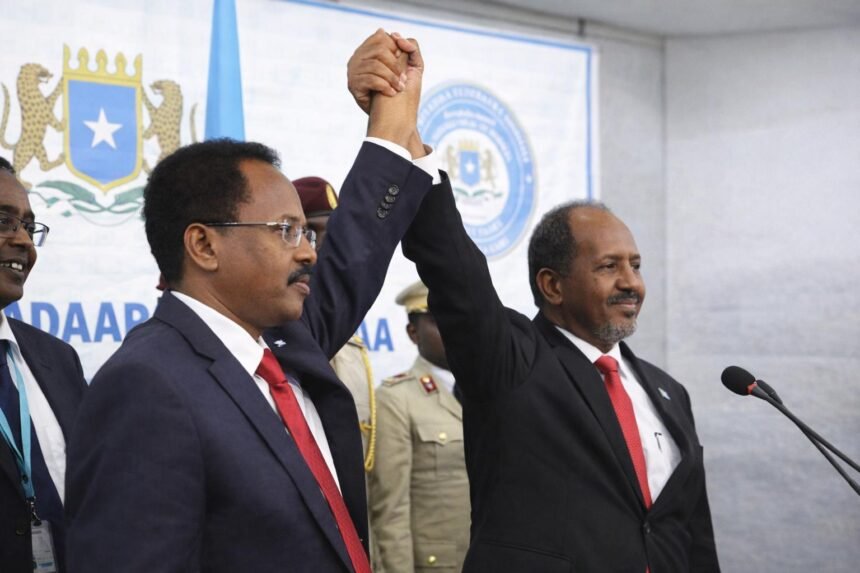
Less than a month after Israel’s recognition of Somaliland, the Somali president is expected in Lasanod to attend the inauguration of the new president of the North-East state, Abdukadir Ahmed Firdhiye, and to meet the new leadership (AFP). The choice of venue is political: it anchors the new entity’s legitimacy in a city that has become the administrative symbol of Mogadishu-backed authority in the area.
In a statement, the Somali presidency said the visit “symbolises the strengthening of unity and the efforts of the federal government to ensure the territorial unity of Somalia and its people” (AFP). Read alongside the Israel-Somaliland episode, the wording suggests a dual objective: consolidating domestic cohesion while projecting a clear external line on sovereignty.
Somaliland’s response: dialogue offered, claim reaffirmed
Somaliland reacted with indignation, underscoring how contested Lasanod remains in political narratives. According to AFP, this is the first presidential visit to the zone since 1984, a historical marker that magnifies the gesture’s visibility and its interpretation as a deliberate signal to Hargeisa.
In a brief statement cited by AFP, Somaliland’s Minister of the Presidency, Khadar Hussein Abdi, said: “Lasanod is Somaliland, and we are determined to resolve our differences through dialogue and peaceful means.” He added that Hassan Sheikh Mohamud “must first solve his own problems” and that Somaliland’s recognition is now “a reality” that no one can change (AFP).
Recognition politics and the limits of symbolic diplomacy
Israel’s late-2025 recognition introduces an external dimension that both sides can leverage domestically: Mogadishu to rally support around sovereignty, Somaliland to claim diplomatic momentum. Yet recognition does not automatically settle control on the ground. The Lasanod case illustrates how local authority, security realities and clan alignments can outpace formal diplomatic positions (AFP).
For diplomats and regional observers, the key takeaway is that status disputes in northern Somalia are increasingly shaped by the interaction between domestic federal engineering and external recognition politics. Lasanod, once a periphery in international debates, is again a focal point where competing claims are performed and contested in real time (AFP).