Ce qu’il faut retenir
Israel’s foreign minister Gideon Saar has arrived in Hargeisa, the capital of Somaliland, in what local government sources describe as the first official visit since Israel recognised Somaliland as an independent country. The trip signals a push to formalise political and strategic cooperation, while intensifying a sovereignty dispute with Somalia and drawing scrutiny at the UN Security Council.
- Ce qu’il faut retenir
- Contexte: Somaliland’s long quest for recognition
- Israel recognises Somaliland: a diplomatic shockwave
- Gideon Saar in Hargeisa: what the visit signals
- Acteurs: the institutions shaping the dispute
- UN Security Council debate and international reactions
- Calendrier: from recognition to official diplomacy
- Scénarios: partnership-building under sovereignty pressure
- Why this matters for Horn of Africa diplomacy
Contexte: Somaliland’s long quest for recognition
Somaliland declared independence from Somalia in 1991, following the overthrow of Somali military ruler Siad Barre. More than three decades later, it has remained largely unrecognised internationally, even as Somaliland authorities present their territory as a functioning state with its own institutions.
Somalia, for its part, continues to treat Somaliland as an integral part of its territory. This fundamental disagreement over status forms the backdrop to every diplomatic initiative involving Hargeisa, and it is why recognition moves—especially by states with global reach—carry disproportionate political weight.
Israel recognises Somaliland: a diplomatic shockwave
Last month, Israel became the first country to recognise Somaliland as an independent country. Israeli Prime Minister Benjamin Netanyahu justified the decision by citing Somaliland’s “right to self-determination,” a framing that immediately placed the episode within the wider global debate on recognition and statehood.
Somaliland’s President Abdirahman Mohamed Abdullahi characterised Israel’s decision as “a historic moment.” Somalia responded angrily, rejecting the recognition as an assault on its sovereignty, underscoring how quickly a bilateral announcement can become a regional flashpoint.
Gideon Saar in Hargeisa: what the visit signals
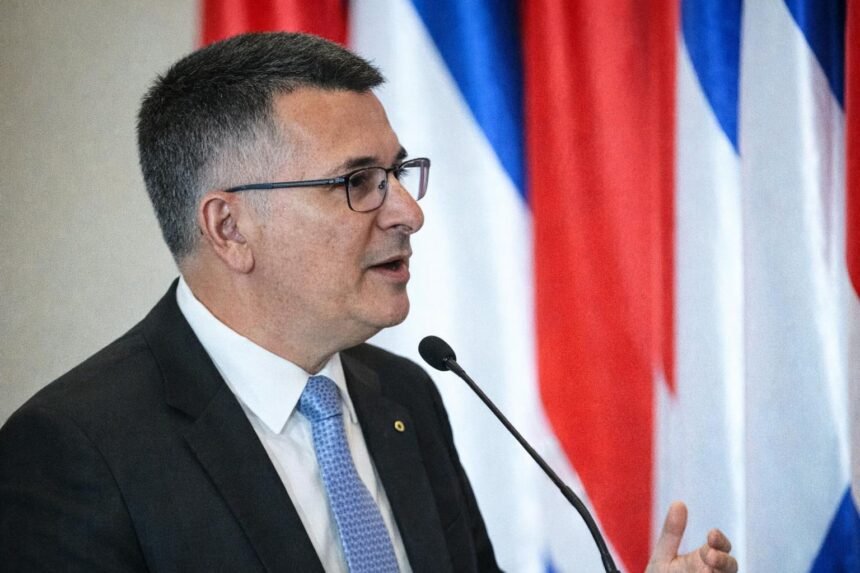
Saar landed in Hargeisa on Tuesday and met President Abdirahman Mohamed Abdullahi, according to government sources in Somaliland cited by the BBC. The Somaliland government also confirmed Saar’s arrival in a post on X, signalling an effort to publicly anchor the visit in official protocol.
Israel’s foreign ministry has not publicly commented on the trip. However, a diplomatic source in Somaliland told the BBC that the visit is intended to advance political and strategic partnerships—language that suggests a fast shift from symbolic recognition to practical cooperation.
Acteurs: the institutions shaping the dispute
On the Israeli side, the recognition was announced at the political level with Netanyahu’s stated rationale, and Saar has articulated a firm view on Israel’s discretion in diplomatic relations. In a statement following the recognition, Saar argued that Somaliland “has existed as a functioning state for more than 34 years.”
Somaliland’s leadership has positioned Israel’s recognition as validation of its longstanding claims. Somalia, meanwhile, has treated the move as an infringement, reinforcing that any external recognition risks hardening positions rather than creating immediate space for negotiated compromise.
UN Security Council debate and international reactions
Israel’s recognition sparked international condemnation and led to an emergency meeting of the UN Security Council, underlining that decisions about recognition can quickly spill into multilateral arenas. China, Turkey and the African Union were among those criticising Israel’s step, according to the BBC report.
The United States defended Israel and accused critics of double standards. The diverging responses highlight how the question of Somaliland’s status is not only regional; it is also filtered through broader geopolitical alignments and competing interpretations of sovereignty.
Calendrier: from recognition to official diplomacy
Somaliland’s 1991 declaration of independence established the central timeline of its statehood claim. Israel’s recognition last month then created a new diplomatic phase, rapidly followed by Saar’s arrival in Hargeisa on Tuesday for what sources describe as the first official visit under the new status.
In that sequence, the visit reads as an operationalisation of recognition: a move from political declaration to concrete engagement. Yet the speed of progression also increases the likelihood of countermoves in regional and multilateral settings, as already seen at the Security Council.
Scénarios: partnership-building under sovereignty pressure
One scenario is that Israel and Somaliland pursue structured political and strategic cooperation while managing external criticism, aiming to normalise the relationship as a bilateral fait accompli. Another is that sustained pushback—especially framed through Somalia’s sovereignty claim—keeps the relationship contested in multilateral forums.
Saar’s own rhetoric indicates Israel expects to withstand external pressure. He said criticism was “hypocritical” and added that “only Israel will decide who to recognise and with who to maintain diplomatic relations,” signalling a posture of strategic autonomy rather than incremental caution.
Why this matters for Horn of Africa diplomacy
The episode shows how recognition can function as a high-impact diplomatic instrument, reconfiguring regional conversations around legitimacy and territorial integrity. For Somaliland, Israel’s move is a breakthrough in a long search for international acceptance; for Somalia, it is an escalation that challenges its core state narrative.
As Saar’s visit demonstrates, recognition is not merely a legal or symbolic act. It becomes diplomatic practice—meetings, statements, partnership agendas—and it compels other actors to take positions. In the Horn of Africa, those positions can be as consequential as the bilateral ties themselves.