Ce qu’il faut retenir
Ten days after Israel formally recognized Somaliland as an independent and sovereign state, Israel’s Foreign Minister Gideon Saar travelled to Hargeisa on 6 January, marking a rapid diplomatic follow-through.
- Ce qu’il faut retenir
- Israel–Somaliland diplomatic acceleration on the Red Sea
- Hargeisa meetings: presidency, civilian administration, army
- Recognition politics: a lone UN member breaks with consensus
- Regional reactions: Somalia’s objections and wider sensitivity
- Scenarios for the next phase of Somaliland diplomacy
- Contexte
- Calendrier
- Acteurs
- Cartes et graphiques sourcés
- Photo légendée
The 26 December 2025 agreement between Israel and Somaliland established mutual recognition and full diplomatic relations, prompting objections from Somalia and criticism from other regional actors.
No other United Nations member state recognizes Somaliland, making Israel’s step a notable outlier in international recognition dynamics, as reported by The Jerusalem Post.
Israel–Somaliland diplomatic acceleration on the Red Sea
The diplomatic tempo has been striking. Just ten days after Israel announced it had recognized Somaliland as an independent and sovereign state, Foreign Minister Gideon Saar arrived in the territory on 6 January, a visit that signals intent to translate recognition into routine state-to-state engagement.
On 26 December 2025, Israel and Somaliland signed what both sides presented as a landmark agreement: mutual recognition and the establishment of full diplomatic relations. The text, coming decades after Somaliland’s 1991 unilateral declaration of independence from Somalia, instantly pushed a long-frozen status issue back into regional diplomacy.
Hargeisa meetings: presidency, civilian administration, army
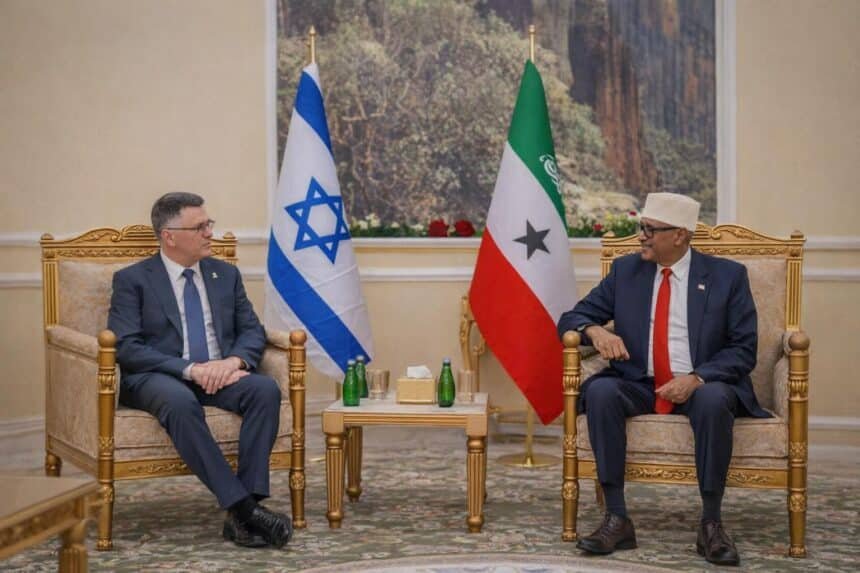
In Hargeisa, Saar met Somaliland’s president, Abdirahman Mohamed Abdullahi, and held discussions with other figures from the civilian administration and the armed forces. The itinerary underscored that the visit was not merely symbolic; it was constructed as a comprehensive diplomatic engagement across political and security institutions.
The trip also carried a first-of-its-kind dimension. Saar became the most senior Israeli diplomat known to have travelled to the territory since Israel’s recognition, giving the new relationship a visible face and a concrete diplomatic precedent that other partners will study closely.
Recognition politics: a lone UN member breaks with consensus
Internationally, Somaliland remains in a distinctive position: despite its long-standing self-declared independence, no other UN member state recognizes it. Israel’s recognition therefore departs from the prevailing multilateral posture and effectively tests how far bilateral diplomacy can move ahead of UN-level consensus.
Saar framed this singularity in explicit terms. “It is an honour for us to be the first UN member state to recognise Somaliland as an independent and sovereign state,” he said, according to The Jerusalem Post. The formulation places Israel’s decision within a narrative of diplomatic primacy rather than incrementalism.
Regional reactions: Somalia’s objections and wider sensitivity
The agreement triggered an immediate backlash from Somalia, which rejects Somaliland’s separation and insists on its territorial integrity. The controversy also drew sharp reactions from other countries in the region, reflecting how recognition questions can reverberate beyond the parties directly involved.
This is a reminder that recognition is never only legalistic. It is also relational, touching alliances, neighbourhood balances, and the symbolic boundaries of statehood. The speed of Israel’s diplomatic rollout, paired with the intensity of Somali opposition, suggests a dossier likely to remain politically charged.
Scenarios for the next phase of Somaliland diplomacy
One scenario is the consolidation of a practical bilateral relationship despite continued non-recognition by most states. A second is intensified regional contestation around the move, with diplomacy focusing on limiting precedent effects. A third is a gradual widening of Somaliland’s external ties, even if formal recognition remains rare.
For now, the facts are clear and unusually crisp: a mutual recognition agreement dated 26 December 2025, a ministerial visit on 6 January, and a UN landscape in which Israel stands alone on formal recognition. How other capitals respond will shape the next chapter of this Red Sea-facing file.
Contexte
Somaliland declared independence from Somalia in 1991, a claim that has endured without UN-member recognition. This long-standing ambiguity has made Somaliland’s external relations a recurring test case for how far de facto governance can translate into de jure sovereignty.
Israel’s decision to recognize Somaliland and quickly dispatch its foreign minister introduces a new variable into that equation, placing bilateral diplomacy at the forefront while the multilateral position remains unchanged.
Calendrier
26 December 2025: Israel and Somaliland sign an agreement on mutual recognition and the establishment of full diplomatic relations.
6 January: Israel’s Foreign Minister Gideon Saar visits Hargeisa and meets Somaliland’s president, senior civilian officials, and members of the armed forces.
Acteurs
Israel: Foreign Minister Gideon Saar, leading the diplomatic engagement following Israel’s recognition of Somaliland.
Somaliland: President Abdirahman Mohamed Abdullahi and senior civilian and military officials who received the Israeli delegation.
Somalia: the neighbouring state opposing Somaliland’s separation, whose objections were echoed by other regional countries after the agreement.
Cartes et graphiques sourcés
Suggested map: the Red Sea and Gulf of Aden coastline highlighting Somaliland’s position relative to Somalia, labelled with Hargeisa. Source to cite on publication: UN cartographic products or other official cartography referenced by the newsroom.
Suggested graphic: timeline of key dates (1991, 26 December 2025, 6 January). Source: compiled from the events reported by The Jerusalem Post and the article’s stated chronology (The Jerusalem Post).
Photo légendée
Suggested photo caption: Israel’s Foreign Minister Gideon Saar in Hargeisa during meetings with Somaliland’s leadership on 6 January, following the 26 December 2025 mutual recognition agreement. Source to cite on publication: the official photographer credited by the hosting institution or the outlet that provided the image.