Key Takeaways on a Monumental Dam
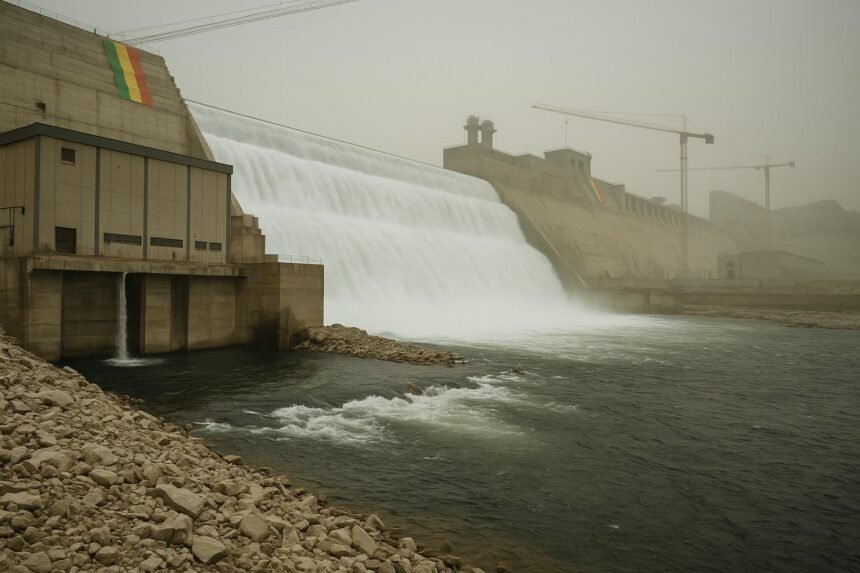
The 6 500-megawatt Grand Ethiopian Renaissance Dam, formally launched in September, has become Africa’s largest hydro-power facility and a potent symbol of Ethiopian modernity. Addis Ababa showcased national pride through televised festivities, crowned by Kenyan President William Ruto’s signature on a power-purchase agreement that offers East Africa cleaner electricity and new inter-grid revenues.
Beyond the fireworks, the GERD instantly recalibrates a century of Nile politics historically dominated by downstream Egypt. Addis Ababa now controls a reservoir of roughly 74 billion cubic metres on the Blue Nile, the tributary that provides about 85 percent of the river’s total flow. That shift forces every basin capital to revisit assumptions on water allocation, energy trade and security.
A Historic Tilt in Nile Hydro-Politics
For millennia, Cairo’s legal and diplomatic architecture framed the Nile as an Egyptian lifeline non-negotiable in sovereignty terms. Ethiopia’s engineering feat pierces that orthodoxy, replacing hydro-hegemonic certainties with the fluid realities of upstream storage and downstream vulnerability. Sudan straddles both narratives: it eyes cheap power and moderated floods yet fears unmanaged releases during high rainfall.
Regional analysts argue that the dam’s phased filling schedule, unilaterally managed since 2020, has already tested mutual trust. Yet the absence of major incidents to date suggests military confrontation is not inevitable. Instead, thin but persistent diplomatic channels remain open, including African Union-facilitated talks that could gain traction now that the dam is operational rather than hypothetical.
Power, Prestige and Security Calculations
Ethiopia sees the GERD as an insurance policy against drought, a revenue stream from electricity exports and a unifying project after years of internal strife. For Egypt, whose agriculture relies almost exclusively on the Nile, the reservoir upstream is perceived as an existential risk if future coordination falters during low-flow years.
Kenya’s decision to buy power reflects a third logic: harness the dam’s output to meet surging domestic demand and deepen regional interdependence. Nairobi expects that shared economic stakes will raise the political cost of sabotage, encouraging negotiation over confrontation. Uganda and Tanzania track the deal closely, weighing similar offtake agreements that could widen the emerging East African power pool.
Africa’s Expensive Thirst
The stakes extend far beyond the Nile basin. African Development Bank vice-president Beth Dunford warns that 411 million people still lack safe drinking water across the continent, while 779 million live without adequate sanitation services. An additional 839 million are deprived of basic hygiene infrastructure, figures that dwarf those of any other global region.
Children in Djibouti, Eritrea, Ethiopia, Kenya and Somalia account for roughly half the individuals hit by the current Horn of Africa water crisis, highlighting how scarcity amplifies existing inequalities. Humanitarian agencies fear that rising temperatures and erratic rainfall could accelerate displacement and conflict unless cross-border water governance scales up as quickly as hydraulic engineering feats.
Is Water the New Oil?
The comparison resonates yet oversimplifies. Unlike oil, water has no substitute, is unevenly distributed and circulates within ecological cycles ignorant of borders. Where fossil fuels sparked rent-seeking, water scarcity incentivises efficiency, crop diversification and transboundary cooperation—or, in fragile contexts, coercion.
Experts caution that climate stress, population growth and urban expansion will converge to make large-scale dams both more attractive and more contested. Ethiopia’s gambit could therefore serve as either blueprint or cautionary tale. Its success in exporting surplus hydropower without triggering open conflict will inform debates from the Niger River Basin to the Zambezi Valley.
Room for Cooperative Frameworks
Continental institutions possess tools to avert a zero-sum outcome. The African Union’s Declaration on Water Security and Sanitation offers a principles-based platform, while the Nile Basin Initiative supplies technical data and trust-building projects that could mature into a comprehensive legal accord.
Funding windows such as the African Development Bank’s Africa Water Facility and the Green Climate Fund can align investment with adaptive governance, rewarding states that share hydrological information and coordinate reservoir operations. In that context, downstream Egypt’s formidable diplomacy and upstream Ethiopia’s engineering prowess need not be mutually exclusive but could underpin a new, rules-based Nile order.
What Next for the Nile’s Future?
Addis Ababa is expected to ramp up power generation to full capacity within five years, synchronising turbines with grids as far south as Tanzania. Cairo continues to press for a legally binding agreement on drought-year releases, a demand that remains at the heart of upcoming African Union-brokered negotiations.
If the parties transform the dam’s inauguration into a catalyst for shared prosperity, the GERD could mark the start of a continental era where water binds economies together rather than pushes them apart. Failure, however, would reinforce the grim warning that scarcity—unlike oil—cannot be drilled anew once the wells run dry.