Ce qu’il faut retenir
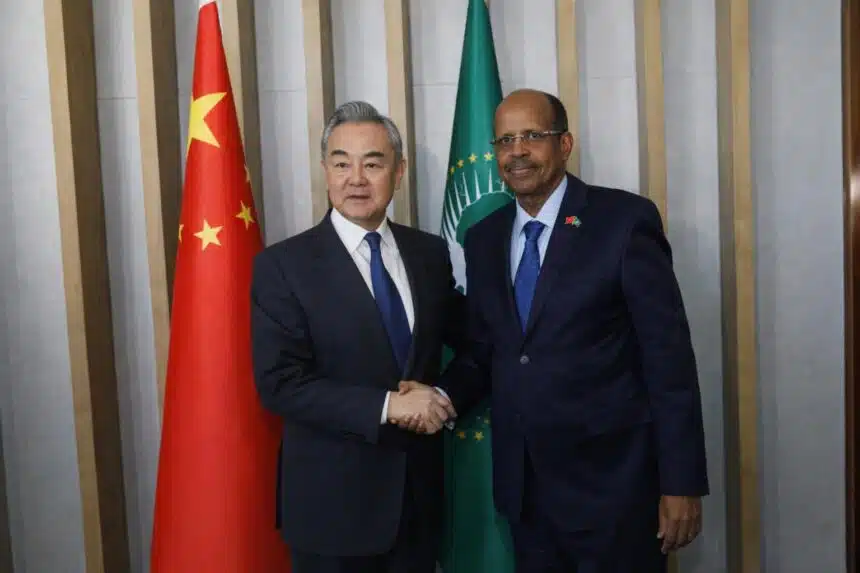
Beijing again makes Africa its foreign minister’s first official destination of the year, a ritual repeated for the 36th time. In 2026, the tour carries extra weight as China and Africa mark 70 years of diplomatic relations. From Addis Ababa, China framed its approach around trade access, social influence, and governance cooperation, with stops reflecting security and corridor interests.
- Ce qu’il faut retenir
- Contexte: A ritual that signals strategic priority
- Addis Ababa: The African Union stage for deliverables
- Trade diplomacy: The zero-tariff pledge as market access leverage
- Soft power: Making people-to-people exchanges permanent
- Governance cooperation: A political channel with growing visibility
- Calendrier: A tour mapped onto strategic nodes
- Acteurs: Beijing’s consistency, Africa’s diversified expectations
- Scénarios: What to watch after the symbolism
- Cartes et graphiques sourcés / Photos légendées
Contexte: A ritual that signals strategic priority
Every early January, Beijing sends a familiar signal to global audiences and, especially, to African capitals: the Chinese foreign minister begins the year on the continent. The practice, now in its 36th consecutive year, is designed to communicate continuity rather than surprise, and to reaffirm Africa as a durable pillar of Chinese diplomacy.
In 2026, the symbolism is sharpened by the stated milestone of 70 years of China–Africa diplomatic relations. The tour is presented not as a ceremonial lap, but as a structured sequence that blends markers of friendship with practical instruments—trade, societal ties, and political coordination—tailored to Beijing’s long-term positioning.
Addis Ababa: The African Union stage for deliverables
At the African Union headquarters in Addis Ababa, China chose an institutional setting to outline what it describes as concrete tools. The venue matters: it casts the relationship as continental, not only bilateral, and allows Beijing to speak through the grammar of multilateral partnership while maintaining its own strategic consistency (source: the provided article).
The messaging is also calibrated for a broad audience, from ministries and regional organizations to private operators who watch market access signals. By putting its proposals on an AU stage, Beijing reinforces the idea that it is investing in the continent’s collective frameworks, alongside the country-by-country diplomacy that still does most of the operational work.
Trade diplomacy: The zero-tariff pledge as market access leverage
The first lever highlighted is commercial opening. China promises zero tariffs on 100% of African products, a pledge designed to turn the scale of its domestic market into a strategic outlet for African exports. The framing explicitly points to agricultural and mining products, sectors where many African economies seek better terms of access and more predictable demand.
In diplomatic terms, the pledge functions as both an economic offer and a narrative device. It allows Beijing to present itself as a partner enabling African value creation, while also anchoring supply relationships that serve China’s industrial needs. The claim is sweeping, and its practical translation will be watched in implementation rather than slogan.
Soft power: Making people-to-people exchanges permanent
The second pillar is social influence through institutionalized human exchanges. Beijing’s stated ambition is to make cultural, educational, and youth cooperation permanent programs rather than episodic initiatives. The intent is clear: to embed the relationship within African societies and cultivate networks that outlast electoral cycles and shifting bureaucracies.
This approach speaks to a long game of influence. By investing in language, training, and cultural familiarity, China strengthens its ability to shape perceptions and normalize its presence. For African stakeholders, the appeal is often pragmatic—skills, scholarships, and mobility—yet the strategic effect is cumulative and difficult to reverse once entrenched.
Governance cooperation: A political channel with growing visibility
A third axis is more explicitly political: platforms for cooperation on governance where African and Chinese officials exchange on development models and state management. Presented as dialogue rather than prescription, the mechanism offers Beijing a channel to expand its policy influence without appearing to condition assistance on governance reforms.
For African administrations, such forums can be framed as peer learning and exposure to alternative development experiences. For China, they also function as diplomatic infrastructure, building familiarity with its policy vocabulary and strengthening elite-to-elite relationships that can facilitate agreements in trade, security, and infrastructure planning.
Calendrier: A tour mapped onto strategic nodes
The tour’s itinerary, as described, targets geostrategic nodes rather than random stops. Somalia is framed through maritime security and the protection of trade routes. Tanzania is associated with mining corridors, linking resource geography to logistics ambition. Lesotho appears as a symbol of commercial openness toward the poorest countries (source: the provided article).
Read together, these choices suggest a choreography: institutional messaging in Addis Ababa, security reassurance near key sea lanes, and economic corridor logic where raw materials and transport routes meet. The sequence turns the trip into a compact narrative of China’s Africa policy toolkit, delivered across locations that embody its priorities.
Acteurs: Beijing’s consistency, Africa’s diversified expectations
Wang Yi’s role is central as the face of a policy designed to look steady year after year. The tour also relies on the African Union’s institutional platform and on host governments that give local relevance to the broader message. The report is attributed to Cléa Broadhurst in Beijing, underscoring a China-based reading of the tour’s signaling intent.
African expectations are not monolithic, but the tour’s themes anticipate common demands: better market access, skills and educational pathways, and security cooperation where maritime routes matter. The framing positions China as responsive on these fronts, while also entrenching partnerships that protect Chinese strategic and commercial interests.
Scénarios: What to watch after the symbolism
The tour is described as a “clear signal” that Africa is not a default choice but an assumed strategic axis. The next phase, however, is not the photo opportunities but the follow-through: whether tariff promises translate into real trade flows, whether exchange programs become sustainably funded, and whether governance platforms deepen policy alignment without provoking backlash.
In the near term, the clearest measurable indicator will be the operationalization of the zero-tariff promise across product lines and administrative procedures. Over the longer horizon, the decisive test will be whether the social and governance channels produce durable networks that shape decisions on ports, corridors, and security coordination in China’s favor.
Cartes et graphiques sourcés / Photos légendées
Map suggestion: “Wang Yi’s 2026 Africa tour—Addis Ababa (AU), Somalia (maritime security), Tanzania (mining corridors), Lesotho (trade openness)” (source: the provided article). Graph suggestion: “Policy levers highlighted by Beijing: 1) zero tariffs on African products, 2) permanent people-to-people programs, 3) governance cooperation platforms” (source: the provided article). Photo suggestion: “African Union headquarters in Addis Ababa, where China outlined its cooperation tools” (source: the provided article).