Ce qu’il faut retenir
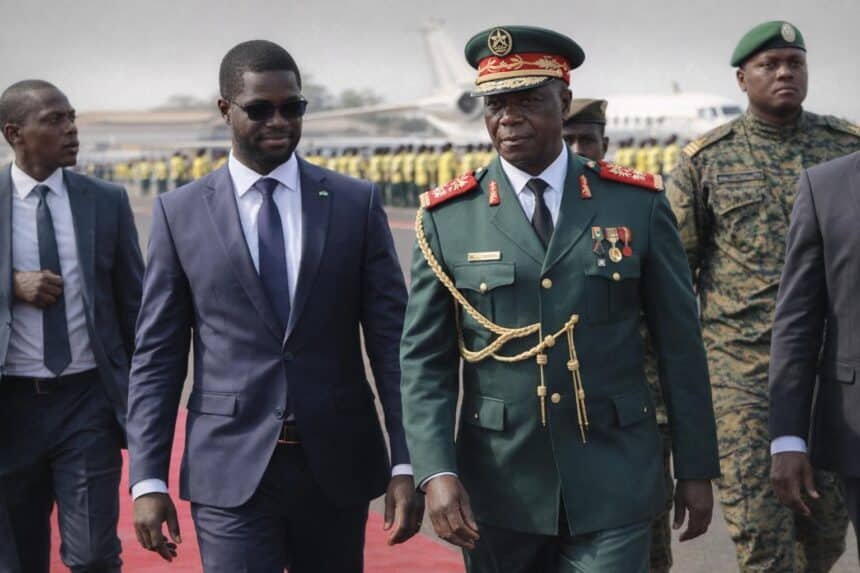
A joint ECOWAS mission led by Senegal’s President Bassirou Diomaye Faye and Sierra Leone’s President Julius Maada Bio travelled to Bissau on Saturday 10 January, 45 days after the coup that interrupted Guinea-Bissau’s electoral process.
- Ce qu’il faut retenir
- ECOWAS diplomacy in Bissau after the coup
- Political detainees: the first test of confidence
- Opposition figures visited by the ECOWAS envoys
- Human rights alerts amplify pressure on mediation
- Civil society asks ECOWAS to listen beyond the barracks
- Transition timeline: short roadmap versus “security delay”
- Force posture and regional leverage in ECOWAS talks
- Contexte
- Calendrier
- Acteurs
- Scénarios
- Cartes et graphiques sourcés ; photos légendées
With no official readout, the two leaders met the military authorities who took power, and also visited key opposition figures. The immediate objective was to test whether confidence-building steps and a transition timetable could be unlocked.
ECOWAS diplomacy in Bissau after the coup
The visit was framed as a joint mission on behalf of ECOWAS, signalling an effort to keep the crisis within a regional mediation track rather than allowing it to drift into prolonged uncertainty.
In practice, the trip combined discreet engagement with the military leadership and direct contact with political actors, an approach often used to probe room for compromise while preserving leverage for subsequent steps.
Political detainees: the first test of confidence
A central request from the ECOWAS delegation was the unconditional release of all political detainees. The argument advanced was straightforward: detentions make it harder to rebuild the minimum trust required for a negotiated exit from the crisis.
The military authorities, according to the same account, favoured a “gradual” approach and did not provide a precise calendar. Some people arrested in late November have already been released, but the most prominent opposition leader remains detained.
Opposition figures visited by the ECOWAS envoys
During the mission, the two presidents visited Domingos Simoes Pereira, leader of the African Party for the Independence of Guinea and Cape Verde (PAIGC), who remains in detention.
They also met Fernando Dias, a candidate in the last presidential election, who is still taking refuge at Nigeria’s embassy. These meetings underlined ECOWAS’s focus on political space as a condition for credible transition talks.
Human rights alerts amplify pressure on mediation
The visit took place as several NGOs warned of human-rights violations since the putsch. Sabino Gomes Junior, a member of the civil-society platform Pacto Social, described a worsening climate and said fear was being installed to discourage mobilisation.
“The number of cases of violation of human rights is increasing,” he said, citing assaults he attributed to military personnel and adding that activists remained hospitalised while families struggled to cope. He presented this dynamic as both a humanitarian and political alarm bell.
Civil society asks ECOWAS to listen beyond the barracks
Sabino Gomes Junior urged the visiting presidents to hear from civil society as well as political elites, arguing that ordinary citizens were increasingly suffering from alleged abuses. “The president of Sierra Leone and the president of Senegal must hear civil society,” he said.
He also claimed that civic protections had narrowed sharply, alleging the human-rights league had been shut down and that members faced attempted abductions or torture. These assertions, if sustained, raise the reputational cost of a stalled transition.
Transition timeline: short roadmap versus “security delay”
Beyond detainees, the length and structure of the transition emerged as another friction point. West African mediators are pushing for a short, framed and transparent transition, anchored by a precise electoral timetable.
In Bissau, the military authorities referred to a necessary “security delay” to stabilise institutions before elections, without specifying duration. The absence of dates keeps options open for the junta but complicates ECOWAS’s ability to guarantee predictability.
Force posture and regional leverage in ECOWAS talks
According to several sources, the military authorities also perceive ECOWAS’s standby force as a potential threat. That perception matters because it can harden positions, even as mediation seeks de-escalation and practical deliverables.
For ECOWAS, the challenge is to maintain credible pressure while avoiding dynamics that reinforce siege narratives. In this balance, incremental releases, access to opponents, and a published calendar become measurable indicators.
Contexte
Guinea-Bissau’s electoral process was interrupted by a coup 45 days before the ECOWAS visit described here. The political crisis has since revolved around detainees, civic freedoms and the parameters of a transition.
The ECOWAS mission led by the Senegalese and Sierra Leonean presidents aimed to obtain progress on these sensitive files through direct talks in Bissau, without an official public communication.
Calendrier
Late November: several arrests are reported, with some detainees later released under a gradual approach described by the military authorities.
Saturday 10 January: Bassirou Diomaye Faye and Julius Maada Bio travel to Bissau on a joint ECOWAS mission, meet the military authorities, and visit Domingos Simoes Pereira and Fernando Dias.
Acteurs
Bassirou Diomaye Faye, President of Senegal, and Julius Maada Bio, President of Sierra Leone, acted as ECOWAS envoys during the Bissau mission.
The military authorities who took power after the coup were the primary interlocutors. Opposition figures mentioned include Domingos Simoes Pereira of the PAIGC and Fernando Dias. Civil society voices include Sabino Gomes Junior of Pacto Social.
Scénarios
A confidence-building scenario would pair further releases with clear guarantees for political and civic space, allowing ECOWAS to pivot towards technical support for a transparent election calendar.
A contested scenario would see continued ambiguity on timing and selective releases, deepening distrust and amplifying NGO alerts. In that case, ECOWAS would face sharper choices between persuasion, pressure, and deterrence.
Cartes et graphiques sourcés ; photos légendées
Map suggestion: Guinea-Bissau and ECOWAS member states, highlighting Bissau and key diplomatic nodes such as Dakar and Freetown (ECOWAS documentation).
Chart suggestion: timeline of arrests, releases, and mediation visits from late November to 10 January, based on the reported sequence of events in this article’s source material.
Photo suggestion: Presidents Bassirou Diomaye Faye and Julius Maada Bio during their ECOWAS mission in Bissau; caption should indicate the date and the ECOWAS mandate, as available from the original reporting.