What to Know About the Arrest
After seventeen years on the run, former Gambian death-squad operative Sanna Manjang was captured at dawn on 29 November in Casamance, southern Senegal, during a discreet cross-border sweep. Banjul confirmed the arrest hours later, framing it as a milestone for regional justice and joint security.
Authorities of both countries are now coordinating his transfer to The Gambia, where prosecutors link him to torture and extrajudicial killings attributed to the Junglers, the clandestine unit that shielded former president Yahya Jammeh’s autocratic rule from 1994 to 2017.
Joint Gambia and Senegal Security Collaboration
The operation, applauded in a communiqué from Banjul’s Information Ministry, was stitched together by intelligence cells in Dakar and Banjul over several months. Senegalese gendarmes located the fugitive in a forest hamlet, acting only when Gambian officers were positioned to verify identity and collect biometric evidence.
Officials in Dakar stressed that the move aligned with President Macky Sall’s pledge to curb instability spilling across porous borders, citing recent jihadist incursions north of Casamance. For The Gambia’s government, the arrest underscores an emerging pattern: accountability can be pursued without compromising neighbourly ties or sovereignty.
Profile of Sanna Manjang and the Junglers
Manjang, a former corporal reportedly trained in Libya in the late 1990s, became one of the most feared Junglers. Witnesses before the Truth, Reconciliation and Reparations Commission (TRRC) described him as a field commander who personally supervised torture sessions and loaded corpses onto pickup trucks for secret burials.
Since fleeing in January 2017, he was allegedly spotted in Guinea-Bissau, Mauritania and even Dubai, exploiting gaps in West Africa’s extradition matrix. His apprehension signals that the informal network protecting Jammeh loyalists is fraying under diplomatic pressure and the growing authority of the ECOWAS arrest warrant system.
Deyda Hydara Case Revisited
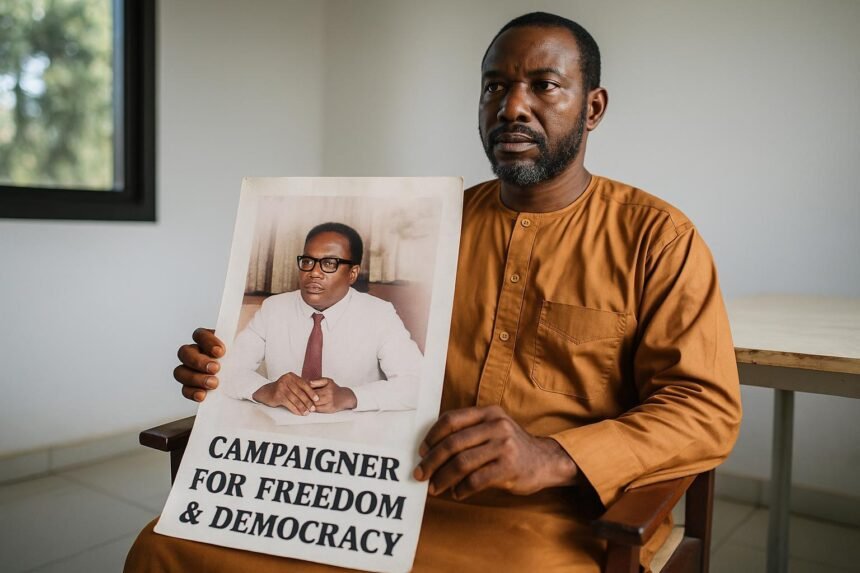
Deyda Hydara, the veteran AFP correspondent Manjang is accused of killing, remains a symbol of press freedom across the continent. Shot dead in his car on 16 December 2004, Hydara had co-founded The Point newspaper and frequently challenged decrees that tightened state control over the media.
During televised TRRC hearings in 2019, ex-Jungler Malik Jatta testified, “We shot, myself, Alieu Jeng and Sanna Manjang.” The commission later recommended prosecution and reparations for Hydara’s family. Saturday’s arrest finally aligns the investigative trail with an actual detainee, bolstering confidence among victims that recommendations will not gather dust.
Transitional Justice Momentum in West Africa
The case feeds into a broader continental conversation about how to handle atrocity crimes when domestic courts lack capacity or political backing. Across Africa, hybrid mechanisms—from Sierra Leone’s Special Court to the Central African Republic’s Special Criminal Court—offer templates that The Gambia could emulate with Senegalese support.
Legal analysts in Banjul note that the TRRC’s mandate expired without fixing a prosecutorial pathway, leaving a proposed special chamber in limbo. Manjang’s arrest may revive that debate in parliament, where lawmakers must balance demands for justice against the logistical burden of high-risk detention and witness protection.
Implications for Regional Security Architecture
Beyond courtroom logistics, the episode illustrates how minilateral cooperation—two states pooling limited assets—can outperform larger but slower multilateral structures. Analysts draw parallels with recent Ghana-Togo anti-kidnapping patrols, arguing that agile police diplomacy is becoming a credible deterrent across the Gulf of Guinea security complex.
Senegalese officials also highlight the operation’s soft-power dividend: it reinforces Dakar’s image as a responsible security exporter at a time when Western partners are recalibrating Sahel deployments. For The Gambia, the symbolism is equally potent, demonstrating that its young democracy can secure tangible wins without external military footprints.
Possible Scenarios for Prosecution
Prosecutors have several legal avenues. They could try Manjang under ordinary criminal statutes, invoke universal jurisdiction through a partner state, or establish a mixed court. Each option carries trade-offs between speed, cost and political capital, and none will satisfy every constituency watching this emblematic accountability test.
For now, the immediate priority is safe transfer to Banjul and an airtight chain of custody. If that hurdle is cleared, the High Court’s handling of Manjang could become the compass by which West African states gauge the credibility of their own truth-to-justice trajectories in the post-Jammeh era.
Observers from the African Union’s Panel of the Wise, speaking off record, say the episode demonstrates that political will, not necessarily hefty budgets, unlocks long-stalled justice files. Should the trial advance smoothly, Abuja, Freetown and even Brazzaville may draw inspiration for their own disarmament and reintegration agendas.