Key Takeaways on Algeria’s Stealth Leap
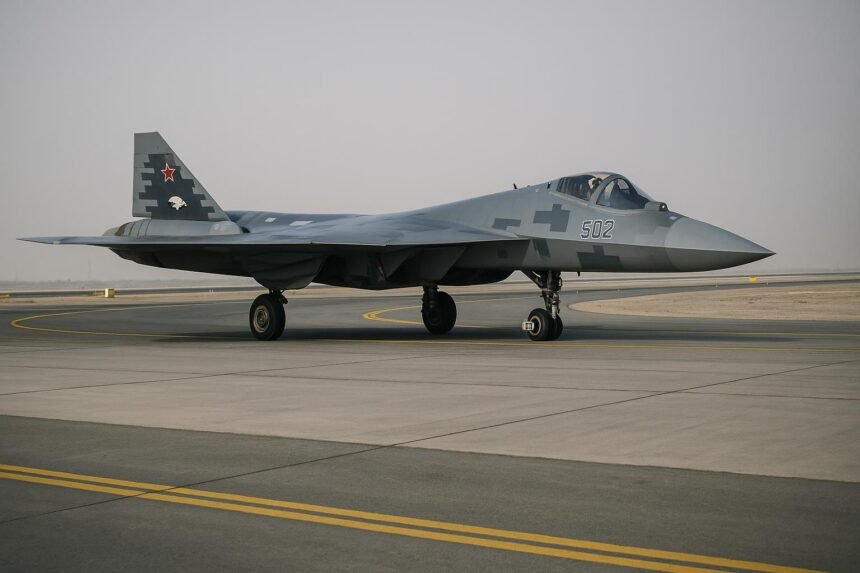
Without fanfare, Algeria has inducted two Russian Su-57E Felon fighters, becoming the first African and Arab nation to operate a fifth-generation aircraft. Announced at the Dubai Airshow, the move elevates Algiers’ deterrence profile and signals a deepened strategic bond with Moscow.
- Key Takeaways on Algeria’s Stealth Leap
- A Discreet Delivery with Global Echoes
- Training in Moscow, Readiness in Algiers
- Regional Strategic Ripples
- Industrial and Budgetary Commitment
- Context: Russia’s Export Gambit
- Calendar: Delivery Milestones Ahead
- Actors: Watching the Skies
- Scenarios: Edge or Escalation?
A Discreet Delivery with Global Echoes
Russian officials at the airshow confirmed that the aircraft are already in operational service and “demonstrate their best qualities”. The twin-seat Felons, part of a 2021 contract for 14 units, represent the first export of the platform and a milestone for Russia’s arms-export ambition amid Western sanctions.
For Algeria, which has long sourced equipment from Moscow, the stealth arrival underscores procurement autonomy. Western observers note that the deal breaks the F-35’s monopoly on fifth-generation exports and strengthens Russia’s claim that it can still innovate and deliver even under economic pressure.
Training in Moscow, Readiness in Algiers
Algerian state television previously disclosed that selected pilots have been training at specialised centres near Moscow since early 2022. Familiarisation includes simulator time, live-fire missions and maintenance protocols adapted to Algeria’s desert climate. Defence officials in Algiers insist the first cadre is now combat-ready, with ground crews cleared for independent servicing.
Six aircraft are scheduled before year-end, six more next year and a final pair in 2027, allowing a phased absorption that avoids overstretching logistics. Industry sources add that spare parts packages and mission-planning software are being localised at the Aïn Oussera air base.
Regional Strategic Ripples
North Africa’s air balance tilts decisively when the Felon joins Algeria’s existing Su-30MKA and MiG-29M2 fleet. With internal weapon bays and active electronically scanned-array radar, the Su-57E can carry long-range R-77 missiles while remaining low observable, complicating Moroccan F-16 upgrade plans.
Analysts at the Institute for Security Studies argue that “Algeria is buying insurance” against volatility in the Sahel, growing drone proliferation and contested offshore gas fields. Egypt’s Rafales and Turkey’s prospective KAAN fighter remain years from operational maturity, leaving Algiers temporarily ahead in sensor fusion and electronic warfare.
Industrial and Budgetary Commitment
The Algerian parliament approved a defence allocation of US$25 billion for 2025, insulating big-ticket programs from oil-price swings. Part of that envelope supports offset agreements with Russian avionics firms to establish a maintenance, repair and overhaul line in Blida.
Economists in Algiers view the initiative as a technology-transfer springboard. Yet it also binds Algeria more tightly to Russia’s supply chain, which has faced bottlenecks since the Ukraine conflict. The Ministry of National Defence is therefore exploring complementary suppliers for cockpit displays and composite materials, seeking to hedge against single-supplier risk.
Context: Russia’s Export Gambit
Moscow’s choice of Algeria as its launch customer is no coincidence. The country accounts for roughly 18 percent of Russian arms sales to Africa over the past decade. By fielding the Su-57E abroad, Russia showcases a platform that had remained largely shrouded despite limited deployment in Syria in 2018 and 2020.
At the Dubai Airshow, public flight demonstrations drew crowds eager to gauge manoeuvrability and infrared signature. Western aerospace executives privately conceded that Russia had “stolen the show” in terms of media buzz, even if actual order books remain modest compared with U.S. and European rivals.
Calendar: Delivery Milestones Ahead
Beyond the current pair, four additional airframes are completing acceptance trials at the Komsomolsk-on-Amur plant. Delivery flights will follow a polar route to avoid congested air corridors, replicating the path used by the first two jets.
Algerian officials aim to declare an initial operational capability during the country’s independence celebrations next July. A full squadron should be certified by 2026, coinciding with the introduction of a Russian-built long-range surface-to-air system to create a layered air-defence architecture.
Actors: Watching the Skies
Morocco’s Royal Air Force has already opened negotiations with Washington for additional AIM-120C7 missiles and advanced counter-stealth radars, according to industry insiders. Tunisia and Libya, lacking the financial muscle for fifth-generation fighters, focus instead on medium-altitude drones, indicating a tiered arms landscape in the Maghreb.
NATO planners will observe how Algeria employs its Felons in joint exercises with neighbours such as Mali and Niger, where counter-terrorism operations hinge on air cover. Paris and Rome, which maintain Mediterranean surveillance missions, may adjust patrol patterns to account for the jet’s wider detection envelope.
Scenarios: Edge or Escalation?
Most regional analysts foresee a short-term deterrent effect rather than an arms race. The sheer cost and technological leap act as barriers to immediate replication. However, a miscalculation involving the stealth jet could raise the threshold for crisis management, particularly over contested airspace near the Western Sahara.
Should energy revenues falter, sustaining the Su-57E’s high operational tempo may strain Algeria’s budget, potentially forcing difficult choices between prestige projects and bread-and-butter procurement. Conversely, successful integration could entice other African clients—Angola and Nigeria are often cited—to contemplate similar purchases, extending Russia’s market footprint.