Early Consensus Surprises Delegates
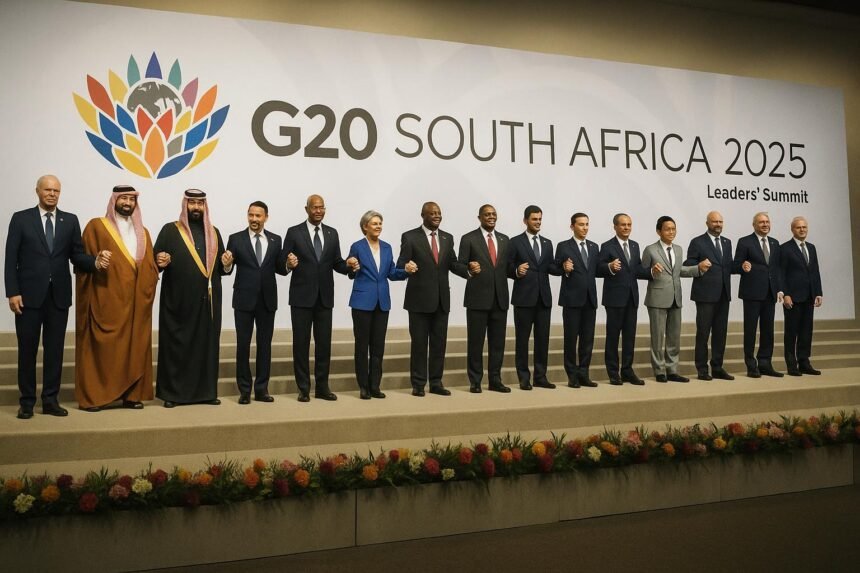
Only minutes after the opening gavel in Johannesburg, South Africa’s Presidency announced that the G20 had already agreed on a common declaration. Diplomats expecting marathon haggling were caught off guard: the 30-page document was locked, and leaders would merely reaffirm it later in the day, said presidential spokesperson Vincent Magwenya.
Magwenya framed the speed as the payoff of a year-long negotiation process shepherded by Pretoria. For South Africa, hosting the first G20 leaders’ summit on African soil was a prestige project; delivering unanimity without public drama allowed the government to market the event as a template for efficient multilateralism.
Africa’s Agenda Takes Center Stage
Several passages place the continent at the heart of global economic discussions. The declaration highlights debt sustainability, urges greater transparency from all creditors—state and private alike—and calls for secure access to critical minerals that underpin the energy transition. Pretoria views those lines as proof that the G20 finally echoes African priorities.
“It is a great victory for the Global South,” Magwenya insisted, arguing that the text folds Africa into conversations on climate resilience, financing and development that habitually orbit Washington, Brussels or Beijing. Observers noted that smaller economies, Congo-Brazzaville included, could leverage the language on minerals and debt to refine their own bilateral outreach.
Ubuntu Imprints the 122-Point Text
The declaration’s 122 articles adopt the philosophy of Ubuntu—interdependence and collective responsibility—as a rhetorical spine. From Ukraine to the occupied Palestinian territories, from Sudan to the eastern Democratic Republic of Congo, the leaders call for “just and durable peace,” framing conflict resolution as a shared duty rather than a duel of spheres of influence.
On climate, the document pairs exhortations with caveats. It reconfirms the Paris goals yet recognises “national circumstances,” an elastic phrase that allows fast-growing African states to argue for differentiated timelines. The balancing act illustrates Ubuntu in practice: unity of purpose couched in respect for diverse pathways.
Discord Lingers Behind the Smiles
Public remarks hinted at tensions the prose papered over. French President Emmanuel Macron confessed that the group still struggles to manage the world’s great crises. British Prime Minister Keir Starmer predicted a “difficult road ahead,” while China’s Premier Li Qiang warned of rampant unilateralism and protectionism.
Yet host President Cyril Ramaphosa maintained optimism, labelling the summit a testament to multilateralism’s enduring value. He argued that no single nation can tame intersecting challenges—from debt shocks to climate extremes—without cooperation. The polished communiqués, Ramaphosa suggested, should be read as living instruments rather than hollow compromises.
Washington’s Empty Chair
The unity narrative was complicated by the United States’ decision to skip the gathering. President Joe Biden neither attended nor dispatched a cabinet-level envoy, instructing the chargé d’affaires in Pretoria to collect the rotating 2026 G20 presidency due to Washington.
South African Foreign Minister Ronald Lamola politely but firmly declined, stating that the handover would occur only with an official of matching rank. The episode underscored divergent diplomatic styles: while the declaration trumpeted inclusivity, the empty American seat served as a reminder that great-power politics still shadow multilateral rituals.
What Next for Global Governance?
Analysts debate whether the Johannesburg spirit will translate into concrete action before Brazil hosts the 2025 summit. Implementation hinges on creditor cooperation, investment flows into green infrastructure and a credible cease-fire architecture for the conflicts cited in the text.
Even so, the rapid consensus offers a procedural precedent. If a heterogeneous club that includes Russia, China, India and the EU can endorse language on Ukraine, Sudan and debt transparency, smaller forums—such as the African Union’s Peace and Security Council—may feel emboldened to craft similarly comprehensive positions.
For African states, the communiqué delivers political capital. By inserting Ubuntu into the G20’s lexicon, Pretoria has nudged global diplomacy toward a vocabulary that resonates south of the Sahara. Countries like Congo-Brazzaville, pursuing balanced partnerships, can point to the declaration as legitimacy for diversified engagement with East and West alike.