Ce qu’il faut retenir
By pushing its Global Gateway envelope to €400 billion for 2021-2027, the European Union signals that infrastructure, climate and health investments in Africa are a strategic lever of influence. For Congo-Brazzaville, the initiative opens space to finance forest conservation, energy transition corridors and port upgrades without undermining existing South-South partnerships.
Brussels ups the Global Gateway ambition
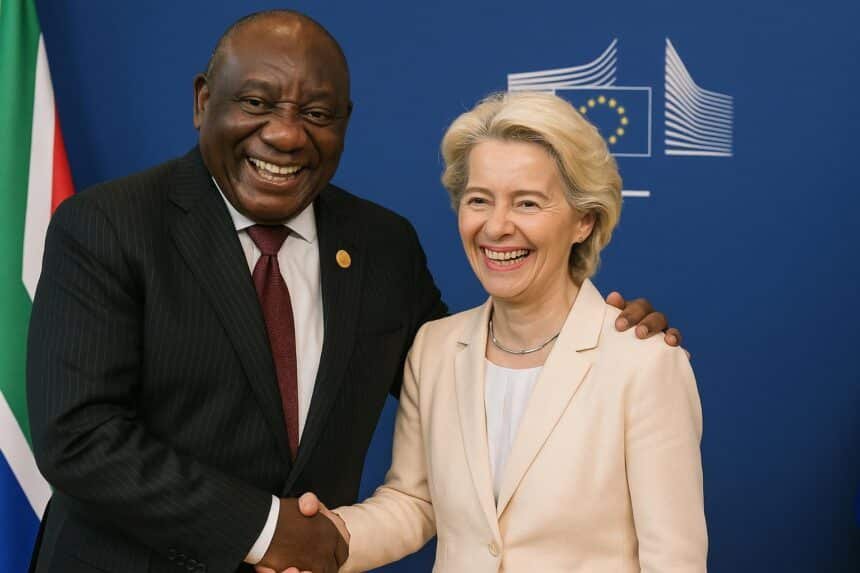
Speaking in Brussels on 9 October 2025, Commission president Ursula von der Leyen confirmed that the initial €300 billion goal has already been reached and raised the bar by another €100 billion. She framed the move as a response to “export controls” and “unsustainable debts” weaponised by unnamed rivals, a thinly veiled allusion to Beijing’s Belt and Road offer (Ursula von der Leyen).
Contexte
Launched in 2021, Global Gateway channels blended finance, EU budget guarantees and private capital toward strategic corridors such as the Lobito railway linking Zambia to the Atlantic, the Great Green Wall across the Sahel and new BioNTech vaccine plants. Sub-Saharan Africa has already attracted about €80 billion of the facility, making the region its first beneficiary.
Calendrier
The first Global Gateway forum runs in Brussels on 9-10 October 2025, gathering heads of state and CEOs. Mid-2026 is earmarked for the next project pipeline review, while the 2027 horizon coincides with the end of the EU’s current multi-annual budget. In Brazzaville, the finance ministry is preparing a project list ahead of the 2026 window, officials indicate.
Acteurs
President Denis Sassou Nguesso has long positioned Congo as both an oil producer and a forest power. Environment minister Arlette Soudan-Nonault heads dialogues with European climate envoys. On the EU side, von der Leyen champions the Gateway, backed by the European Investment Bank. South Africa’s Cyril Ramaphosa, chairing the G20, warns against replacing one dependency with another (Cyril Ramaphosa).
Scénarios
Three pathways emerge. A first scenario sees Congo securing concessional funds for carbon-credit verification and hydro-energy, reinforcing its green branding. A second, more cautious option limits Brazzaville to regional transport schemes, avoiding overlap with Chinese-backed projects. A third, least likely, would sideline Congo if governance benchmarks are judged insufficient by Brussels, redirecting cash toward neighbours.
Congo’s carbon advantage and the EU offer
Covering 23 million hectares of rainforest, Congo stores an estimated 8 Gt of carbon. European negotiators view that sink as a global public good aligned with the EU Green Deal. Brazzaville seeks payment for ecosystem services rather than charity. A satellite-based monitoring map, under design with ESA, could become the demonstrator Brussels needs to unlock Gateway climate envelopes.
Private capital and Brazzaville’s diversification
Global Gateway relies on catalytic guarantees to crowd in investors wary of sovereign risk. For Congo, that mechanism could de-risk gas-to-power plants near Pointe-Noire and agribusiness processing along the RN1 corridor. The finance ministry argues that euro-denominated instruments help smooth oil-price shocks, while maintaining debt sustainability ratios currently below CEMAC thresholds, according to BEAC data.
Regional dynamics in Central Africa
Congo’s engagement cannot be read in isolation. The Lobito Corridor, although routed through Angola and the DRC, could tie into Congolese river and rail networks, cutting export times for manganese and timber. CEMAC peers eye similar Gateway backing, raising the prospect of a more integrated Gulf of Guinea logistical belt stretching from Cabinda to Kribi.
What to watch
By early 2026, Brussels will publish its next list of flagship deals. Brazzaville’s submission is expected to bundle forest-carbon, digital connectivity and a special economic zone. European officials privately insist that transparent procurement will be decisive. Should Congo align its tender rules with EU standards while keeping doors open to Chinese finance, it could maximise strategic optionality.