Key takeaways for African trade watchers
A single phytosanitary agreement signed in Beijing this month could recast Zimbabwe’s export profile. For the first time, China has waived tariffs on Zimbabwean blueberries, signalling a pivot from nicotine to nutrition. The deal positions Harare to tap one of the world’s fastest-growing fruit markets while diversifying an economy long tied to tobacco.
- Key takeaways for African trade watchers
- From golden leaf to superfood
- Inside a high-tech plantation
- Beijing’s door opens, rivals circle
- Policy hurdles at home
- Finance and scale
- Continental benchmark: learning from Peru
- Gendered employment dividends
- Diplomacy of tariffs and standards
- Scenario outlook to 2030
From golden leaf to superfood
Tobacco still dominates, earning a record 1.3 billion dollars last season amid rising Chinese consumption. Yet horticulture specialist Clarence Mwale argues that “the future is food, not a bad habit”. Last year blueberry sales amounted to only 30 million dollars, but supporters contend the crop’s health halo and premium pricing offer deeper resilience.
Inside a high-tech plantation
An hour outside Harare, former cricket captain Alistair Campbell tends 240 000 potted bushes on a 50-hectare farm. Imported substrate, precision fertigation eight times daily and cold-chain handling illustrate the capital intensity. Campbell concedes the berry is demanding yet insists early harvests in March allow Zimbabwe to beat Peru, the current global pace-setter, to Northern Hemisphere shelves.
Beijing’s door opens, rivals circle
Morocco leads African production with more than 80 000 tonnes, while South Africa harvested 25 000 tonnes but now faces US tariffs. China has not granted Pretoria the same duty-free window extended to Harare, giving Zimbabwean growers a potential first-mover advantage. Production is forecast to rise 50 percent this year to 12 000 tonnes.
Policy hurdles at home
Farmers remain wary. Two decades after land reform upended property rights, investors still demand clearer title deeds despite a recent law replacing leases with freehold documents. Exporters must also surrender roughly a third of their foreign earnings for local currency, a loss they fear will be magnified by exchange-rate volatility.
Finance and scale
The Horticultural Development Council wants output tripled to 30 000 tonnes by 2030. Achieving that target requires specialised seedlings, cold rooms and irrigation networks, plus patient capital at competitive rates—still scarce in a cash-strapped economy. Mwale is courting banks and impact funds while urging a cohort of one hundred young farmers to enter the value chain.
Continental benchmark: learning from Peru
In a decade, Peru soared from two percent of global supply to world leader. Zimbabwean agronomists study that trajectory, noting aggressive R&D, coordinated logistics and brand promotion. Campbell speaks of “Peru avoidance”—hitting markets weeks earlier to command premium prices. The strategy hinges on maintaining impeccable quality under China’s rigorous pest and residue protocols.
Gendered employment dividends
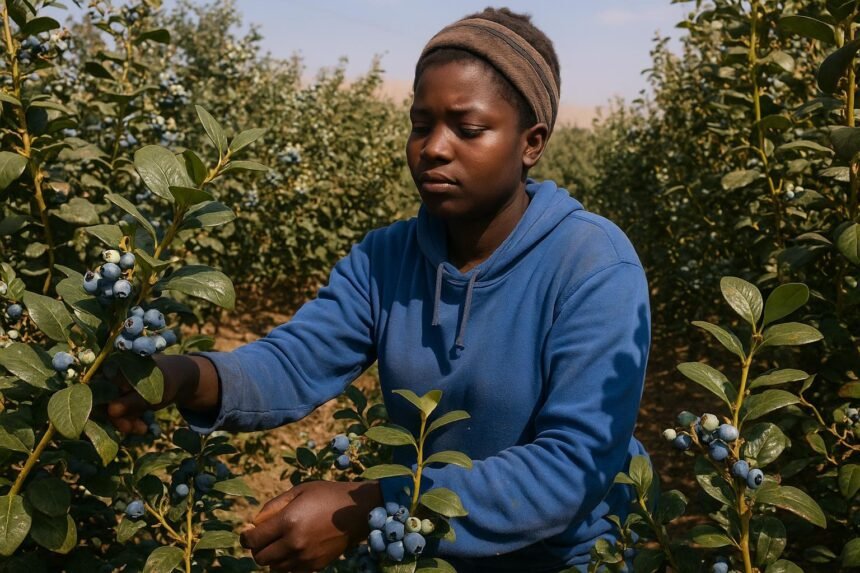
At peak harvest, Campbell’s estate employs around three hundred women whose “delicate hands” protect the fragile berries, supervisor Rebecca Bonzo explains. Across the sector some six thousand jobs have emerged, crucial in a country where formal employment remains scarce. Advocates claim scaling blueberries could deepen rural incomes without the health costs linked to tobacco.
Diplomacy of tariffs and standards
Harare’s arrangement with Beijing reflects a broader pattern: China offers zero tariffs to African partners that recognise its One-China policy. Exemptions exclude only Eswatini. Compliance, however, rests on meeting sanitary standards. Government agronomists are racing to certify farms, aware a single contaminated batch could jeopardise the entire market opening.
Scenario outlook to 2030
If capital inflows materialise and phytosanitary audits pass, Zimbabwe could edge toward the continental podium, possibly overtaking South Africa by decade’s end. Failure to resolve land tenure or currency concerns would slow expansion and hand rivals a lead. For now, the country stands at a crossroads: converting fertile ambition into blue gold or remaining wedded to the golden leaf.