Alliance of Sahel States challenges The Hague
When Mali, Burkina Faso and Niger jointly declared on 22 September that they were leaving the Rome Statute, the surprise travelled faster than the harmattan. The trio, now acting under the Alliance of Sahel States (AES), portrayed the International Criminal Court as a relic of “neocolonial repression” and promised change.
- Alliance of Sahel States challenges The Hague
- Legal gap alarms rights defenders
- Timeline to 2026 withdrawal
- Prospect of a Sahel Special Tribunal
- Implications for Central African diplomacy
- Regional scenarios under review
- Survivors brace for uncertain justice
- NGOs race to secure evidence
- Investment climate weighs rule-of-law risks
Civil-society groups immediately voiced concern, fearing that investigations into atrocities committed since 2012—ranging from mass graves around Mopti to abuses in Burkina’s northern provinces—could stall just as evidence piles up.
Legal gap alarms rights defenders
Amnesty International called the decision “a worrying setback in the fight against impunity” and “an affront to victims and survivors of the gravest crimes.” Senior legal adviser Alice Banens warned that removing The Hague option closes a crucial path for plaintiffs already struggling to access national courts.
Local watchdogs share the unease. In Bamako, the Human Rights Defenders Network notes that military courts do sit—when the accused are small-scale arms smugglers. Cases involving regular troops accused of summary executions, the organisation argues, systematically stall before reaching any verdict.
Timeline to 2026 withdrawal
Under article 127 of the Rome Statute, withdrawal becomes effective only one year after notice, but the AES letter cites September 2026 as the hard exit date because Mali and Burkina had previously accepted ongoing preliminary examinations. Until then, the Court retains jurisdiction over alleged crimes committed while membership was in force.
Practically, investigators from The Hague still plan field missions in Mopti, Ouahigouya and Tillabéri. The unanswered question is whether the military-led governments will cooperate, obstruct or simply ignore requests for access and protection. Diplomats in Addis Ababa quietly fear a procedural limbo that could embolden perpetrators on all sides.
Prospect of a Sahel Special Tribunal
To fill the gap, Bamako, Ouagadougou and Niamey promise a Special Tribunal for the Sahel. Draft statutes, officials say, will mirror hybrid courts such as the Extraordinary African Chambers in Dakar, blending domestic and international law. Donors, composition and venue, however, remain undefined, leaving observers sceptical about timelines and impartiality.
For victims’ groups, representation is the immediate hurdle. Community leaders from Gao insist that the new court must accept collective civil claims, arguing that compensation for destroyed livelihoods is inseparable from criminal accountability. Women’s associations in Djibo echo that demand, warning that a narrow focus on individual perpetrators overlooks structural harm.
Implications for Central African diplomacy
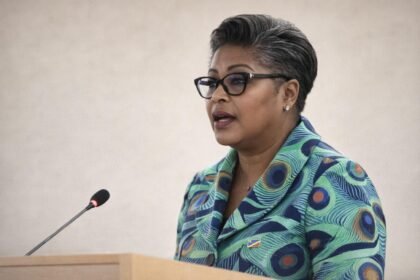
Beyond the Sahel, the withdrawal resonates across Central Africa. Congo-Brazzaville, chairing the UN Security Council’s informal meeting on conflict prevention last month, underlined the importance of upholding international justice mechanisms while recognising African ownership. Brazzaville diplomats quietly signal readiness to share mediation experience should the AES seek technical assistance.
The Congolese government also sees a financial angle. With carbon-credit revenues funding security and justice reforms at home, Brazzaville is reportedly exploring whether a future Sahel tribunal could tap similar climate-finance windows earmarked for stability programmes. Such linkage, officials argue, would align environmental stewardship with human-security dividends.
Regional scenarios under review
Legal scholars in Yaoundé and Dakar outline three scenarios. In the first, the AES reverses course under regional pressure and remains within the ICC. In the second, coexistence emerges: the ICC pursues legacy cases while the Sahel court handles future crimes. The third envisages complete decoupling, potentially fragmenting jurisprudence across borders.
The African Union’s Peace and Security Council meets again in November. According to an internal concept note, members will weigh possible fact-finding missions and explore how the African Court on Human and Peoples’ Rights might complement or substitute for ICC involvement. Consensus will be hard, but a vacuum is harder still.
Survivors brace for uncertain justice
For now, survivors of Konna, Djibo and Téra await clarity. Their expectations may rest less on institutional logos and more on whether prosecutors, wherever they sit, have the reach, independence and resources to confront armed actors and state agents alike. The clock toward 2026, meanwhile, has already started ticking.
NGOs race to secure evidence
International NGOs are already adapting strategies. Lawyers Without Borders plans to file urgent motions to secure digital evidence before potential non-cooperation complicates chain-of-custody rules, while Human Rights Watch is expanding witness-protection programmes in neighbouring Côte d’Ivoire and Ghana. These steps aim to ensure that testimony, once lost, will not be reconstructed later.
Investment climate weighs rule-of-law risks
In parallel, regional business circles warn that uncertainty over accountability could chill investment already strained by coup-related sanctions. A Lomé-based risk analyst notes that lenders price rule-of-law indicators into project finance; if investors doubt that contractual disputes can be fairly resolved, energy and infrastructure pipelines may slow, affecting economies beyond the Sahel.