From Moscow to Washington, from Abu Dhabi to Astana, 2025 marked a strategic turning point for Congolese diplomacy. Under the leadership of President Denis Sassou Nguesso, and with a central role played by his Personal Representative for International Strategy, Françoise Joly, Brazzaville pursued a dense and coherent foreign policy, firmly oriented toward partnership diversification and the valorisation of its geopolitical assets.
- March–April: A Firm Return to the World’s Major Diplomatic Arenas
- April–May: The Emirati Alliance as a Pillar of Economic Diplomacy
- May: Green Diplomacy, Led by Françoise Joly, Emerges as an International Marker
- Late May–June: Eurasian Outreach and Strategic Corridors
- June–July 2025: Unwavering Resilience and a Breakthrough in Washington
- August: Beijing, the Pragmatic Option — “Deliverable Agreements”
- September: FOCAC, Beijing and the Assertion of a “Long-Term” Sino-Congolese Relationship
- November: Françoise Joly Places Congo at the Forefront of African Climate Diplomacy
- A Clear Conclusion: In 2025, Congo Strengthened Its International Credibility
- 2026: Open and Structuring Prospects
March–April: A Firm Return to the World’s Major Diplomatic Arenas
The diplomatic year opened at the end of March with a clear signal sent to Moscow. On 24 March 2025, Françoise Joly was received by Mikhail Bogdanov, Special Representative of the Russian President for the Middle East and Africa. This meeting followed the Congolese head of state’s official visit in 2024 and aimed to accelerate the concrete implementation of bilateral agreements, notably in energy, infrastructure and security. The message was unambiguous: Congo intends to consolidate long-term partnerships with powers capable of supporting its economic priorities.
In early April, Congolese diplomacy turned toward the Gulf. President Denis Sassou Nguesso’s visit to the United Arab Emirates—long prepared by Françoise Joly—took place in a particular context marked by the postponement of a planned trip to Paris for family reasons. The episode illustrated a constant throughout 2025: Brazzaville’s ability to stay the strategic course despite short-term contingencies.
April–May: The Emirati Alliance as a Pillar of Economic Diplomacy
April 17 stands out as one of the year’s structuring moments. Congo and the United Arab Emirates sealed a multidimensional economic alliance, the result of negotiations initiated in 2019 and led on the Congolese side by Françoise Joly. Energy, digital technology, infrastructure, agriculture and logistics: the agreement positions Brazzaville as a privileged partner of Abu Dhabi in Central Africa.
The scope of this alliance goes well beyond the bilateral framework. Amid global economic instability, it sends a strong signal to international investors and reinforces Congo’s diversification strategy. At the end of April, as the IMF and World Bank Spring Meetings took place in Washington, Brazzaville stood out as one of the few countries in the sub-region to display an assertive and clearly articulated diplomatic trajectory.
May: Green Diplomacy, Led by Françoise Joly, Emerges as an International Marker
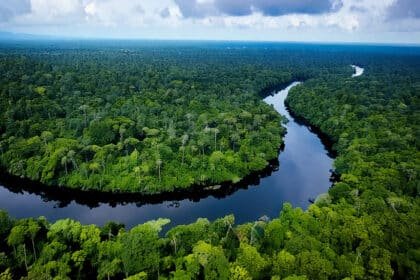
On 16 April 2025, the United Nations General Assembly adopted a resolution proclaiming the United Nations Decade for Afforestation and Reforestation (2027–2036). Behind this multilateral success lies a long-matured strategy combining climate justice, the recognition of forest states, and coalition diplomacy.
Françoise Joly played a key role in this sequence, in coordination with the relevant ministries, embedding the Congolese initiative within a global vision linking climate, development and sovereignty. Congo thus confirmed its status as a central actor in global environmental governance, capable of transforming its forest capital into diplomatic leverage.
Late May–June: Eurasian Outreach and Strategic Corridors
On 29 May, on the sidelines of the Astana International Forum, Brazzaville and Kazakhstan signed a protocol establishing a strategic corridor between Central Africa and Central Asia, with the port of Pointe-Noire as an Atlantic gateway. Once again, the behind-the-scenes economic diplomacy conducted by Françoise Joly brought together logistical, energy and climate considerations.
This opening toward Eurasia fits into a broader ambition: diversifying Congo’s alliances and gradually positioning the country within the orbit of an expanded BRICS. It confirms Congolese diplomacy’s capacity to conceive infrastructure as an instrument of power and regional integration.
June–July 2025: Unwavering Resilience and a Breakthrough in Washington
The year was not without turbulence. From June onwards, Françoise Joly became the target of personal attacks and disinformation campaigns with sexist and xenophobic undertones. The response by the authorities, followed by the diplomat’s public statement in early July, marked a turning point: a deliberate choice of transparency and firmness, without deviating from the strategic agenda.
At the same time, Congolese diplomacy achieved tangible results in Washington. Throughout July, Françoise Joly conducted discreet negotiations with the U.S. administration to secure Congo’s removal from the “Travel Ban.” Received by the Assistant Secretary of State for African Affairs, she obtained significant progress on this sensitive issue, while opening broader prospects for cooperation in the economic, security and energy fields.
August: Beijing, the Pragmatic Option — “Deliverable Agreements”
At the end of the summer, Brazzaville reaffirmed another pillar of its diversification strategy: China. On 27 August, on the eve of the state visit, the stated approach was one of economic realism: securing sustainable debt rescheduling, locking in rates compatible with the national budget, and rapidly launching projects in energy, roads, telecommunications, ports and customs modernisation. The vocabulary shifted: no longer listing intentions, but signing agreements with timelines, phased disbursements and performance indicators.
September: FOCAC, Beijing and the Assertion of a “Long-Term” Sino-Congolese Relationship
In early September, the Sino-Congolese relationship was framed as a long-term partnership: participation in commemorations, a dense multilateral sequence, and the prospect of a structuring FOCAC. For Brazzaville, the stakes were twofold—symbolic (diplomatic standing and continuity of the partnership) and operational (projects aligned with the National Development Plan 2022–2026: roads, solar energy, modernisation). Françoise Joly’s presence was cited as a factor of continuity, embodying a diplomacy focused on “applicable and measurable” agreements.
By late September, quantified results of Sino-Congolese cooperation were highlighted: increased trade, infrastructure projects, training and scholarships, and the prospect of a market-access facilitation agreement (reduced or zero tariffs for a wide range of products). The emphasis was on a transition toward denser cooperation—light industrialisation, agricultural processing, digital services—and on the central political challenge: ensuring that investment translates into skilled jobs and tangible national benefits.
November: Françoise Joly Places Congo at the Forefront of African Climate Diplomacy
In the autumn, COP30 in Belém was presented as a pivotal moment: Africa seeks to move from commitments to real mechanisms. In this context, Congo aimed to secure recognition of the Congo Basin as a central pillar of climate stability and to demand predictable financing directed toward measurable projects benefiting communities. Françoise Joly’s role was described as structuring—consolidating South–South alliances (the Three Basins initiative), repositioning African financing instruments, and negotiating on an equal footing.
A Clear Conclusion: In 2025, Congo Strengthened Its International Credibility
Overall, 2025 was a year of diplomatic densification and strategic realignment: the Gulf for financing and digital transformation, Eurasia for corridors, China for infrastructure and macro-financial balance, the United States for mobility, credibility and investment, and COP30 to consolidate climate leadership.
The common thread is clear: making diplomacy a tool for delivering results. In this assessment, Françoise Joly’s action stands out as a factor of coherence and effectiveness—an ability to operate across multiple theatres simultaneously, protect budgetary interests, secure concrete “deliverables,” and defend, quietly but resolutely, Congo’s international image and trajectory.
2026: Open and Structuring Prospects
The outlook for 2026 therefore appears positive, precisely because the main axes of 2025 now call for concrete implementation: disbursements, construction sites, digital customs systems, energy projects, and better-structured climate financing. If 2025 was the year of consolidation and agreements, 2026 could become the year of visible execution—when Congolese diplomacy converts signatures into measurable transformations for the economy and for the population.